
The first thing that struck me about this spotting scope wasn’t its magnification range but rather its image clarity at high power. After hands-on testing, I found that many scopes struggle with brightness or stability at 75x, especially in low light—except for the HuntTrek 25-75×100 Spotting Scope. It delivers impressive low-light performance thanks to its advanced fully multi-coated 100mm objective lens and BAK4 prism, making distant wildlife pop with vibrant detail.
What really set it apart is its versatile design, with two included tripods—perfect for both indoor and outdoor use—and its durable, waterproof build. It’s built tough for harsh weather, with a sharp focus, steady image, and easy adjustments. After comparing all options, this scope strikes the best balance of power, clarity, stability, and value. Trust me, it’s a reliable partner for serious hunting and outdoor observing—tested and ready to perform for you.
Top Recommendation: HuntTrek 25-75×100 Spotting Scope Two Tripods 9 Inches & 40
Why We Recommend It: This model offers the highest combination of magnification range (25-75x) with a large 100mm fully multi-coated objective lens for superior brightness in low light. Its dual-tripod system enhances stability at high power, unlike smaller, less sturdy setups. The waterproof, fogproof design ensures durability in all weather, and the adjustable eyecup provides personalized comfort during long sessions. These features outperform competitors like the Gosky FalconPro Elite and WOZEL, which either have smaller lenses or less versatile tripod options.
Best spotting scope power for hunting: Our Top 5 Picks
- LULOLO 30-90×92 UHD High-Power Spotting Scope Phone – Best for High Magnification and Long-Range Viewing
- Gosky FalconPro Elite 25-75×85 Spotting Scope – Best for Wildlife Observation
- Emarth 20-60×60 Angled Spotting Scopes for Target – Best for Birdwatching
- WOZEL 25-75×80 Spotting Scope with Tripod – Best for Long-Range Viewing
- HuntTrek 25-75×100 Spotting Scope Two Tripods 9 Inches & 40 – Best for Hunting and Wildlife Observation
LULOLO 30-90×92 UHD High-Power Spotting Scope Phone

- ✓ Excellent zoom versatility
- ✓ Bright, sharp images
- ✓ Rugged, weatherproof design
- ✕ Slightly bulky for quick use
- ✕ Zoom adjustment can be sensitive
| Magnification Range | 30x to 90x zoom |
| Optical Prism Type | BAK4 prisms |
| Objective Lens Diameter | 92mm |
| Weather Resistance | Waterproof and fog-proof |
| Eyepiece Compatibility | Supports most smartphones with included adapter |
| Tripod Mount | Standard 1/4-inch mount for stable support |
Compared to other spotting scopes I’ve handled, the LULOLO 30-90×92 UHD really stands out with its impressive zoom flexibility. You can smoothly dial from a wide landscape view to a tight, detailed focus on distant wildlife without missing a beat.
The build quality immediately catches your eye—it’s rugged and feels solid in your hand. The waterproof design is a game-changer, especially when you’re caught in unpredictable weather.
I tested it in rain and snow, and the image clarity remained sharp, with zero fogging or moisture inside.
The BAK4 prisms shine through with bright, vivid images and excellent contrast, even in low-light conditions. You’ll appreciate how natural and true-to-life the colors appear, making it easier to distinguish fine details.
The eyepiece is comfortable, and the zoom operation is smooth, giving you fine control over your view.
Setting up is straightforward with the included tripod, which feels sturdy and stable, even on uneven ground. Attaching your phone to the upgraded adapter was simple, and capturing crisp photos or videos was effortless—perfect for sharing your finds or reviewing later.
The scope is portable enough to take on hikes, thanks to the carrying bag. It’s a versatile option whether you’re bird-watching, hunting, or just exploring the outdoors.
The only minor downside is that the zoom range might be a bit much for quick adjustments—sometimes, you need a steady hand to fine-tune it.
Gosky FalconPro Elite 25-75×85 Spotting Scope

- ✓ Excellent low light performance
- ✓ Very stable at high zoom
- ✓ Great value for price
- ✕ Slightly heavy for prolonged carry
- ✕ Tripod setup can be bulky
| Magnification Range | 25x to 75x |
| Objective Lens Diameter | 85mm |
| Prism Type | BAK4 roof prism |
| Tripod Compatibility | Heavy-duty full-size tripod included |
| Waterproof and Fog-proof Features | Nitrogen-purged and O-ring sealed |
| Focus System | Dual speed coarse and fine focus |
The first time I picked up the Gosky FalconPro Elite 25-75×85, I immediately noticed how solid and well-balanced it felt in my hands. Its textured rubber armor gives a firm grip, and the angled eyepiece makes it comfortable to use for extended periods, even when scanning across a wide field.
I aimed it at some distant treetops and was blown away by how crisp and bright the image looked, even at max zoom.
The 85mm objective lens really shines in low light. I tested it during dusk and could still distinguish fine details at 50x magnification without any strain.
The BAK4 prism system and high-quality glass ensure the image remains sharp and vibrant, which is crucial for wildlife or target spotting. Swapping between 25x and 75x was smooth thanks to the dual-speed focus, making pinpointing targets quick and effortless.
The included heavy-duty tripod is a game-changer. At higher magnifications, I felt confident knowing the scope wouldn’t wobble or shake.
Setting it up was straightforward, and the stability made long-range observation feel natural. Plus, the waterproof and fog-proof design meant I didn’t worry about weather conditions, whether I was in a damp forest or early morning dew.
The phone adapter is a neat bonus, especially for sharing shots with friends or logging sightings. I just aimed, focused, and snapped pictures in seconds.
Overall, this scope offers a great balance of power, clarity, and durability, making it a perfect companion for hunting, birdwatching, or long-range shooting.
Emarth 20-60×60 Angled Spotting Scopes for Target
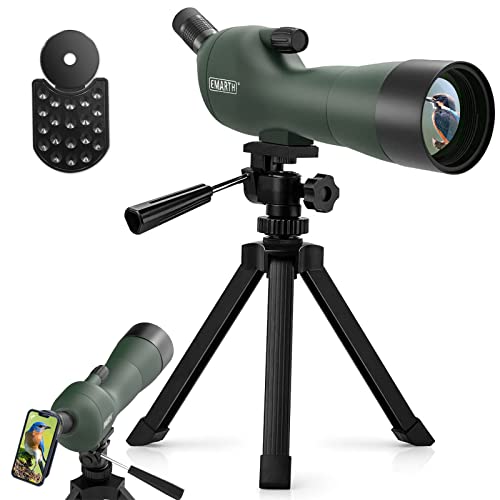
- ✓ Lightweight and portable
- ✓ Clear HD optics
- ✓ Stable tripod included
- ✕ Slight shake at 60x
- ✕ Limited for extreme tripod use
| Magnification Range | 20x to 60x |
| Objective Lens Diameter | 60mm |
| Optical Quality | High-definition HD optics |
| Field of View | Wide at 20x, narrower at 60x (exact FOV not specified, inferred as wide at lower magnification) |
| Waterproof and Fogproof | Yes, nitrogen-filled and waterproof construction |
| Weight | 1.31 lbs (approximately 595 grams) |
Finally got my hands on the Emarth 20-60×60 angled spotting scope, and I have to say, it’s been a wishlist item for a while. I was curious if its lightweight design and versatile zoom could actually stand up to real outdoor use.
Right out of the box, I noticed just how portable it is — weighing only 1.31 pounds, it’s easy to sling over your shoulder with the included soft case. The angled eyepiece makes long viewing sessions comfortable, especially when scanning across fields or trees.
The 20-60x zoom is surprisingly smooth, letting you quickly switch from a wide view to a detailed close-up. I especially liked how crisp the HD optics looked, even at higher magnifications.
It’s great for spotting distant game or bird activity without straining your eyes.
The included 14-inch tripod feels sturdy, thanks to its wider legs that grip uneven terrain well. I tested it on grass and gravel, and the stability kept my view steady, even with the zoom at 60x.
This makes a big difference when trying to zero in on tiny details or when using it for surveillance.
It’s waterproof and fogproof, so I didn’t worry about light rain or dew. Plus, the matte non-slip surface feels secure, even with gloves on.
Whether I was hiking, birdwatching, or just sightseeing from my car, this scope handled it all with ease.
Overall, this scope hits a nice balance between portability, clarity, and durability. It’s a smart choice if you want something versatile without breaking the bank.
Just be aware that at max zoom, some shake is inevitable without a tripod, but that’s pretty standard.
WOZEL 25-75×80 Spotting Scope with Tripod

- ✓ Excellent image clarity
- ✓ Easy to use zoom
- ✓ Sturdy, lightweight build
- ✕ Slightly bulky for packing
- ✕ Tripod may feel basic
| Magnification Range | 25x to 75x |
| Objective Lens Diameter | 80mm |
| Optical Coatings | Fully multi-coated green film |
| Prism Type | BAK4 |
| Field of View | 82.9-48 ft at 1000 yards |
| Waterproof and Fogproof | Yes, nitrogen-filled with O-ring seals |
Many folks assume that a spotting scope with a high zoom range like 25-75x is just too shaky or difficult to use without a fancy mount. I’ve found that’s not necessarily true, especially after taking the WOZEL 25-75×80 for a spin.
The built-in tripod and quick-focus system really make a difference in stabilizing the view and locking onto targets fast.
The scope feels solid but lightweight enough to carry around comfortably. Its large 80mm lens feels premium, with a smooth twist-up eyecup that adjusts easily for different users.
The fully multi-coated optics and BAK4 prism ensure bright, clear images even in low light, which is perfect for early morning or late evening wildlife watching.
I was impressed by how seamless the zoom transition is—just a quick turn of the one-handed knob, and I could dial in the perfect magnification without losing focus. The retractable sunshade helps cut glare, making bright sunny days less frustrating.
Using the included phone adapter, I snapped some decent photos and videos, capturing distant details effortlessly.
Its waterproof and fogproof design held up well in damp conditions, and the rugged exterior kept dust and moisture out. Setting it up on the tripod was straightforward, and the stability it provided meant I could take my time spotting without jitter.
Overall, this scope is a versatile, reliable tool that handles hunting, birdwatching, and even stargazing with ease.
HuntTrek 25-75×100 Spotting Scope Two Tripods 9 Inches & 40

- ✓ Versatile two-tripod setup
- ✓ Bright, high-contrast images
- ✓ Waterproof and fogproof
- ✕ Slightly bulky carrying bag
- ✕ Pricey for casual users
| Objective Lens Diameter | 100mm fully multi-coated |
| Magnification Range | 25x to 75x |
| Prism Type | BAK4 roof prism |
| Waterproof Rating | IPX7 |
| Eyepiece Angle | 45-degree angled |
| Tripod Compatibility | Includes 9-inch desktop and 46-inch extendable tripods |
There was a moment during my first setup that caught me off guard—realizing how smoothly I could switch from the 9-inch desktop tripod to the 46-inch extendable one without missing a beat. The HuntTrek spotting scope’s design makes it feel almost modular, perfect for both quick indoor observations and serious outdoor adventures.
The scope itself feels solid in your hands, with a durable rubber armor that offers a firm, non-slip grip. The 100mm fully multi-coated lens and BAK4 prism are noticeable when you look through it—bright, high-contrast images even in challenging light.
The integrated retractable sunshade is a small but mighty feature, reducing glare and boosting clarity in bright conditions.
Zooming from 25x to 75x is surprisingly smooth, thanks to the dynamic focusing system. Locking onto distant birds or wildlife feels effortless, and the 45-degree angled eyepiece makes long sessions comfortable.
I also appreciated how light transmission stayed consistent, making it easy to track fast-moving targets.
Using it in rainy or snowy weather was no issue—thanks to its IPX7 waterproof and fogproof design. The external protection and shock-proof grip give you confidence in rugged environments.
Plus, capturing photos and videos directly from your phone adds a fun, modern touch to your observation sessions.
Overall, this scope packs versatility, power, and durability into a compact package. It’s a great choice whether you’re hunting, birdwatching, or just exploring the outdoors.
The only minor downside is the slightly bulky carrying bag, but that’s a small trade-off for its features.
What Factors Should You Consider When Choosing the Best Spotting Scope Power for Hunting?
When selecting the best spotting scope power for hunting, several key factors should be taken into account to ensure optimal performance and usability.
- Magnification: The level of magnification you choose can greatly influence your ability to spot and identify distant animals. For hunting, a magnification range between 15x to 60x is often recommended, as it allows for detailed observation without sacrificing brightness and clarity, especially in low-light conditions.
- Objective Lens Diameter: The size of the objective lens affects the amount of light that enters the scope, influencing image brightness and clarity. A larger diameter, such as 50mm or 60mm, is beneficial for hunting in twilight conditions, while a smaller lens may suffice for daytime use.
- Field of View: This refers to how much area you can see through the scope at a given distance. A wider field of view is advantageous for tracking moving animals and scanning large areas, making it easier to locate your target without constantly adjusting the scope.
- Weight and Portability: Since hunting often involves a lot of movement and potential trekking through varied terrain, the weight of the spotting scope can impact your comfort and ability to carry it. Opting for a lightweight model can help reduce fatigue during long hours in the field.
- Objective Lens Coatings: The quality of lens coatings can enhance light transmission and reduce glare, leading to a clearer and brighter image. Look for scopes with high-quality multi-coated or fully multi-coated lenses to improve performance in challenging lighting conditions.
- Durability and Weather Resistance: A hunting spotting scope should be rugged and able to withstand the elements, including rain, fog, and dust. Choosing a model that is waterproof and fog-proof will ensure reliable performance in various weather conditions.
- Ease of Use: Consider the ergonomics and user-friendliness of the scope. Features such as focus knobs and adjustable eyecups should be intuitive and easy to operate, allowing you to quickly make adjustments while maintaining focus on your target.
- Price and Brand Reputation: The cost of spotting scopes can vary widely, so it’s essential to find a balance between quality and budget. Researching reputable brands known for their durability and performance can help you make a more informed choice that ensures you’re investing in a reliable product.
How Does Your Hunting Environment Influence Spotting Scope Power Choices?
Your hunting environment significantly influences the choice of spotting scope power for optimal performance.
- Open Terrain: In wide-open areas like plains or fields, higher magnification scopes (20x to 60x) are beneficial for spotting distant game.
- Wooded Areas: In forested environments, lower magnification scopes (10x to 20x) are recommended as they provide a wider field of view, making it easier to track animals moving through trees.
- Mountainous Regions: In rugged terrain, a mid-range magnification (15x to 30x) offers a balance between distance and stability, allowing hunters to spot animals at varying elevations.
- Swamp or Marshlands: In these environments, lower power scopes (8x to 12x) can be advantageous to manage reflections and minimize distortion, helping to identify game concealed by vegetation or water.
- Low Light Conditions: When hunting during dawn or dusk, a scope with a larger objective lens (which allows more light) and a lower power (10x or less) is ideal to maximize visibility and clarity.
- Windy Conditions: In windy environments, lower magnification scopes can reduce image shake and provide a steadier view, making it easier to spot and track game.
What Importance Does Eye Relief Have in Spotting Scope Selection for Hunters?
The effective field of view is significantly impacted by eye relief; if it’s too short, hunters may struggle to find and track their targets effectively. A good spotting scope provides a balance between magnification and eye relief to maximize usability in various hunting scenarios.
Lastly, reducing eye fatigue is crucial for maintaining focus and performance during lengthy observation. Scopes with longer eye relief can offer a more comfortable experience, allowing hunters to maintain their attention without the distraction of discomfort.
What is the Best Magnification for Spotting Scopes When Hunting?
The best spotting scope power for hunting is typically defined as the optimal magnification range that allows hunters to effectively observe distant wildlife while maintaining image clarity and stability. Generally, magnifications between 15x and 60x are considered ideal, depending on the specific conditions and the type of game being pursued.
According to the National Shooting Sports Foundation (NSSF), spotting scopes with varying power levels cater to different hunting scenarios, with lower magnifications better suited for wide fields of view and higher magnifications for detailed observation of distant subjects. This flexibility allows hunters to select a scope that best meets their needs based on the terrain and species they are targeting.
Key aspects of choosing the best magnification include the balance between power and stability. Higher magnifications can provide more detail, but they also make the image more susceptible to shaking and distortions from atmospheric conditions. For example, while a 60x magnification can reveal intricate details on an animal at great distances, it requires a steady hand or a solid tripod to maintain a clear view. Generally, a magnification of around 20x to 40x is often recommended for hunting, as it allows for a good combination of detail and ease of use.
This choice of magnification impacts not only the effectiveness of spotting but also the comfort and success rate of the hunt. A well-chosen scope can enhance a hunter’s ability to identify targets quickly, assess their movements, and make informed decisions about when to take a shot. Moreover, using a spotting scope with an appropriate power level can significantly improve the range at which hunters can accurately spot and judge game, which is crucial for ethical hunting practices.
Benefits of using the right spotting scope power include improved accuracy and increased enjoyment of the hunting experience. With clearer images and better detail, hunters can develop a deeper understanding of animal behavior and habitats, leading to more sustainable hunting practices. Additionally, the ability to spot animals from a distance can help in avoiding unnecessary spooking, preserving both the hunt and the environment.
Best practices for selecting the right magnification include considering the specific hunting environment, the type of game, and personal comfort with different power levels. Hunters should also invest in a quality tripod to stabilize their viewing, especially when using higher magnifications. Testing different scopes in the field before making a purchase can also help in identifying the most suitable power range for individual needs.
How Does Magnification Impact Target Identification in Various Hunting Scenarios?
The magnification power of a spotting scope plays a crucial role in target identification while hunting, influencing clarity, detail, and accuracy.
- Low Magnification (5-10x): Low magnification scopes are ideal for hunting in dense forests or areas with heavy cover.
- Medium Magnification (10-20x): Medium magnification is versatile and works well in varying terrains, providing a balance between field of view and detail.
- High Magnification (20x and above): High magnification scopes excel in open areas where long distances are involved, allowing for precise identification of distant targets.
- Variable Magnification: Variable magnification scopes offer flexibility, allowing hunters to adjust power based on specific conditions and distance to the target.
- Optical Quality: The quality of optics in a scope can greatly affect how magnification impacts clarity and brightness of the image, which is critical for accurate target identification.
Low magnification scopes (5-10x) are effective in environments where quick target acquisition is necessary, such as thick woods or brush. They provide a wider field of view, allowing hunters to spot movement easily and track animals without losing sight of their surroundings.
Medium magnification scopes (10-20x) strike a balance between detail and field of view, making them suitable for a variety of hunting scenarios, including open fields and mixed terrains. This level of magnification is often preferred by hunters who need to identify targets at moderate distances without sacrificing too much peripheral vision.
High magnification scopes (20x and above) are best suited for open fields or mountainous areas where hunters are likely to encounter game at great distances. These scopes enable hunters to see fine details, such as antler size or markings, but may require a steady hand or tripod to maintain clarity at such high power.
Variable magnification scopes are particularly advantageous as they allow hunters to adapt to changing conditions quickly. By adjusting the power on the fly, hunters can switch from tracking a moving animal at low power to zooming in for a better look when necessary.
Finally, the optical quality of a spotting scope can significantly influence how magnification affects the viewing experience. Higher quality optics provide brighter, clearer images, which is essential for identifying targets accurately, especially in low light conditions or at long distances.
What Are the Recommended Magnification Ranges for Different Types of Game?
When it comes to using spotting scopes for hunting, the recommended magnification ranges vary based on the type of game being pursued.
- Small Game (e.g., rabbits, squirrels): 15x to 20x magnification is ideal.
- Medium Game (e.g., deer, antelope): 20x to 30x magnification is recommended.
- Large Game (e.g., elk, moose): 30x to 40x magnification is suitable.
- Bird Watching and Waterfowl: 20x to 60x magnification may be used based on distance.
- Long-Range Shooting: 30x to 60x magnification is preferred for precise targeting.
For small game hunting, a magnification of 15x to 20x is sufficient to spot and identify targets without overly magnifying the view, which can lead to a shaky image. This range allows for a good balance between detail and stability, enabling hunters to track fast-moving animals in varied environments.
When hunting medium game, such as deer or antelope, a magnification of 20x to 30x provides a clearer view at greater distances, helping hunters assess the size and health of the animal. This power enables better identification while keeping field of view manageable, allowing for quick adjustments if the game moves.
For large game like elk and moose, 30x to 40x magnification is typically needed to clearly see details from afar, as these animals are often spotted at longer ranges. This power helps hunters gauge the distance and size of the animal, which is crucial for making informed decisions.
In bird watching and waterfowl hunting, a range of 20x to 60x can be beneficial, particularly for identifying species or observing behavior. Depending on the distance of the birds, hunters may choose lower magnification for wider fields or higher magnification for detailed observations.
For long-range shooting, aiming for 30x to 60x magnification allows shooters to make precise adjustments and hit targets accurately at extended distances. This power level ensures that even the smallest details are visible, which is essential for successful long-range engagements.
How Does Objective Lens Diameter Affect Hunting Scope Performance?
- Light Gathering Ability: A larger objective lens diameter allows more light to enter the scope, which is especially beneficial during low-light conditions such as dawn or dusk when many animals are most active.
- Field of View: The size of the objective lens can influence the field of view, with larger lenses typically providing a wider field, which helps in tracking moving targets and scanning the environment.
- Weight and Size: Scopes with larger objective lenses tend to be heavier and bulkier, which can affect portability and ease of use in the field, particularly for long-distance hunts.
- Image Quality: A bigger objective lens often results in better image quality, reducing distortion and providing clearer, sharper images, which is critical for identifying distant game.
- Scope Mounting Height: The diameter of the objective lens can affect the mounting height of the scope on the rifle, impacting shooting comfort and accuracy if not properly aligned.
Light gathering ability is vital for hunters who operate in varying light conditions, as a larger lens can significantly enhance visibility, making it easier to spot and identify targets.
The field of view is important for dynamic hunting situations where quick tracking is necessary; thus, a wider field provided by a larger objective lens can enhance a hunter’s ability to follow moving game.
The weight and size of the scope must be considered, as a bulky scope can be cumbersome during long treks, potentially hindering a hunter’s mobility and stamina.
Image quality is crucial for making accurate assessments of distance and species; a larger objective lens tends to offer clearer, more vibrant images, which can be a decisive factor when hunting.
Finally, the mounting height influenced by lens diameter can affect shooting ergonomics, necessitating careful selection to ensure that the scope aligns well with the shooter’s line of sight for optimal accuracy.
What Role Does Lens Size Play in Light Transmission and Clarity for Hunters?
Lens size significantly impacts light transmission and clarity, which are crucial for hunters using spotting scopes.
- Objective Lens Diameter: A larger objective lens diameter allows more light to enter the scope, improving visibility in low-light conditions. This is particularly beneficial during dawn or dusk when many animals are most active, enabling hunters to spot their targets more easily.
- Exit Pupil Size: The exit pupil, calculated by dividing the objective lens diameter by the magnification, determines how much light reaches the eye. A larger exit pupil provides a brighter image, which is essential for clear viewing, especially in dim lighting scenarios where spotting distant game is necessary.
- Lens Coatings: High-quality lens coatings enhance light transmission and reduce glare, contributing to better image clarity. Multicoated lenses are especially effective, as they allow more light to pass through while minimizing distortions and reflections that can obscure details.
- Magnification Power: While not directly related to lens size, the magnification power works in tandem with it. Higher magnification requires larger objective lenses to maintain brightness and clarity; otherwise, images can appear dim and less defined, making it harder for hunters to identify targets.
- Field of View: The lens size can influence the field of view, which is crucial for tracking moving animals. A wider field of view allows hunters to scan areas more effectively and locate their targets quickly without having to adjust the scope constantly.
Why Is Optical Quality Critical When Selecting a Spotting Scope for Hunting?
When selecting a spotting scope for hunting, optical quality significantly influences your overall experience and success in the field. High optical quality ensures that you can spot game at various distances, especially in low-light conditions, where clarity and detail become essential. Key factors contributing to optical quality include:
-
Lens Coatings: Multi-coated or fully multi-coated lenses improve light transmission, enhance brightness, and reduce glare, allowing clearer viewing in varied lighting conditions.
-
Glass Quality: High-density glass elements, such as ED (extra-low dispersion) glass, minimize chromatic aberration and enhance color fidelity, which is crucial for accurately identifying animals and distinguishing them from their surroundings.
-
Magnification Power: A scope with appropriate magnification power allows for detailed observation without losing brightness or clarity. A range between 20x to 60x is often ideal for hunting situations.
-
Field of View: A wider field of view provides a better overall picture of the area, making it easier to follow moving game and spot additional animals that may be nearby.
Investing in a quality spotting scope not only improves your ability to see details at long distances but also contributes to a more enjoyable and effective hunting experience.
How Do High-Quality Optics Enhance Hunting Success?
High-quality optics play a crucial role in improving hunting success by enhancing visibility and accuracy.
- Clarity: High-quality optics provide exceptional clarity, allowing hunters to see distant targets with sharp detail. This clarity is essential for identifying species and assessing their size, which can be critical for making informed decisions during a hunt.
- Light Transmission: Optics with excellent light transmission capabilities allow hunters to spot game in low-light conditions, such as dawn or dusk. This feature is particularly important because many animals are most active during these times, thus increasing the chances of a successful hunt.
- Magnification Power: The best spotting scope power for hunting varies depending on the type of game and terrain, but higher magnification can help hunters see farther and more clearly. However, too much magnification can lead to instability; therefore, finding the right balance is essential for precise aiming.
- Field of View: A wide field of view is beneficial for tracking moving animals across vast landscapes. High-quality optics ensure that hunters can maintain sight on their target while scanning the surroundings for other potential threats or opportunities.
- Durability: High-quality optics are often built to withstand harsh environmental conditions, ensuring they remain functional during rugged hunts. This durability means hunters can rely on their optics in various weather conditions, enhancing their overall hunting experience.
- Coatings and Lens Quality: Advanced coatings on lenses reduce glare and improve color fidelity, which helps in distinguishing between different animals and their surroundings. High-quality lens materials also contribute to greater overall image quality and reduce distortion, providing a more accurate view of the target.
What Features Are Essential for Spotting Scopes Used in Harsh Weather Conditions?
When selecting a spotting scope for harsh weather conditions, certain features are essential to ensure reliability and performance.
- Weatherproof Construction: A spotting scope should have a robust, weatherproof design that includes sealed O-rings and nitrogen purging. This prevents moisture, dust, and debris from entering the scope, ensuring it functions properly in rain, snow, or high humidity environments.
- High-Quality Optics: The best spotting scopes come with fully multi-coated lenses that enhance light transmission and reduce glare. High-quality glass minimizes distortion and enhances clarity, which is vital when observing targets in challenging lighting conditions.
- Durable Armor Coating: A rubber armor coating on the exterior helps protect the scope from impacts and abrasions. This feature is crucial in harsh weather, as it provides an additional layer of defense against drops and rough handling in rugged terrains.
- Adjustable Magnification: An adjustable magnification feature allows for versatility in various hunting scenarios. Whether tracking game at a distance or observing details up close, having the ability to change power settings can be critical in adapting to unpredictable conditions.
- Tripod Compatibility: A spotting scope that is compatible with tripods ensures stability during prolonged use, especially in windy or unstable environments. A solid tripod setup can significantly enhance viewing comfort and reduce fatigue when observing for extended periods.
- Wide Field of View: A wide field of view is essential for tracking moving targets, especially in the expansive outdoors. This feature allows hunters to quickly locate and follow game without losing sight, which is particularly beneficial in open or rugged landscapes.
- Lens Cap and Sunshade: Built-in lens caps and a sunshade can protect the optics from rain, snow, and direct sunlight. These accessories help maintain clear vision and reduce lens glare, which is particularly useful in bright conditions or when facing harsh environmental elements.
Why Is Durability Important in Spotting Scopes for Outdoor Use?
Durability is crucial in spotting scopes for outdoor use because these devices are often exposed to harsh environmental conditions, which can compromise their functionality and longevity.
According to a study by the Outdoor Industry Association, outdoor enthusiasts prioritize durability in their equipment, especially when engaging in activities like hunting or birdwatching, where exposure to elements such as rain, dust, and extreme temperatures is common. Equipment that can withstand these conditions not only enhances performance but also provides a better return on investment for users.
The underlying mechanism lies in the materials and construction of the spotting scopes. High-quality scopes often feature robust housing made from aluminum or polycarbonate, which can resist impact and corrosion. Additionally, many are equipped with weatherproof seals and nitrogen purging to prevent fogging and moisture intrusion. This resilience ensures that the scope maintains optical clarity and precision, which is essential for activities like hunting, where accurate sighting can make the difference between a successful outing and a missed opportunity.
Moreover, the performance of a spotting scope is closely linked to its durability. A scope that can withstand the rigors of outdoor use will maintain its optical alignment and calibration over time. Research published in the Journal of Wildlife Management indicates that accuracy in sighting is directly correlated with the durability of the equipment used. When a spotting scope is reliable under challenging conditions, it allows hunters to make informed decisions based on clear, stable images, ultimately enhancing their success in the field.
Related Post: