
The first thing that struck me about the Vortex Diamondback HD Spotting Scope 20-60×85 Angled wasn’t just its powerful zoom but how surprisingly clear and bright it performed in low-light conditions. After hands-on testing, I noticed its HD optical system delivers exceptional resolution, even at full magnification, with minimal chromatic aberration. Its sleek design and built-in sunshade made it easy to use during dawn or dusk—perfect for nature and wildlife viewing.
This scope’s adjustable eyecups and compatibility with Arca-Swiss tripods made quick setups effortless, giving me sharp, detailed images on rugged terrains. I also appreciated its waterproof, fogproof build, combined with durable Armortek coatings. All these features—plus the lifetime VIP warranty—justify its higher price. After rigorous comparison, it’s clear this scope offers the best blend of optical quality, durability, and user-friendly features, making it the top choice for serious enthusiasts and hunters alike.
Top Recommendation: Vortex Diamondback HD Spotting Scope 20-60×85 Angled
Why We Recommend It: This scope excels with its HD optical system, providing outstanding resolution, color fidelity, and low-light performance. Its built-in sunshade and waterproof, fogproof construction handle harsh conditions, while the Arca-Swiss compatibility ensures easy tripod mounting. Unlike others, it combines high magnification, superb clarity, and rugged durability—offering the best value for demanding outdoor use.
Best spotting scope on the market: Our Top 5 Picks
- Vortex Diamondback HD Spotting Scope 20-60×85 Angled – Best for Versatility and Clarity
- Gosky FalconPro Elite 25-75×85 Spotting Scope – Best Premium Spotting Scope
- Vortex Crossfire HD Spotting Scopes (12-36×50 Angled) – Best for Budget-Conscious Enthusiasts
- Smartphone Adapter for Binoculars, Monoculars & Telescopes – Best for Smartphone Photography
- Emarth 20-60×60 Angled Spotting Scopes for Target – Best Cheap and Inexpensive Spotting Scope
Vortex Diamondback HD Spotting Scope 20-60×85 Angled

- ✓ Outstanding low-light performance
- ✓ Sharp, clear image quality
- ✓ Easy to focus quickly
- ✕ Slightly heavy for backpacking
- ✕ Price might be steep for some
| Magnification Range | 20-60x |
| Objective Lens Diameter | 85mm |
| Optical System | HD optical system with multiple anti-reflective coatings |
| Field of View | Variable depending on magnification (not specified, but typically wide at 20x and narrower at 60x) |
| Waterproof and Fogproof | Yes, O-ring sealed and argon purged |
| Tripod Compatibility | Arca-Swiss compatible and accepts 1/4-20 threaded mounts |
The moment I looked through the Vortex Diamondback HD 20-60×85 Angled Spotting Scope, I was struck by how bright and detailed everything appeared, even in low light. Its large 85mm objective lens really makes a difference when you’re trying to spot distant wildlife at dawn or dusk.
The HD optical system delivers crisp resolution from edge to edge. Chromatic aberration is minimal, so colors stay true and sharp across the entire view.
I love how the coatings boost light transmission, making everything look vibrant without any glare or dullness.
The built-in helical focus wheel is smooth and precise, allowing quick adjustments without fuss. Twisting it feels natural and fine-tuned, which is perfect when you’re trying to settle on a distant bird or animal.
The adjustable eyecups twist up and down comfortably, even with glasses on.
Portability and mounting options are a breeze with this scope. It’s tripod adaptable and Arca-Swiss compatible, which means you can mount it securely on most tripods or even a vehicle window mount.
The rugged rubber armor adds a nice grip and extra protection, while the waterproof and fogproof seals mean you’re covered in all weather.
Overall, this scope feels built for serious outdoor use. The clarity, brightness, and quick focusing make it stand out.
Plus, the lifetime warranty gives peace of mind, knowing it’s a long-term investment for wildlife enthusiasts or birdwatchers alike.
Gosky FalconPro Elite 25-75×85 Spotting Scope

- ✓ Excellent low light performance
- ✓ Stable at high magnification
- ✓ Easy to focus for beginners
- ✕ Slightly heavy for extended carry
- ✕ Tripod may be bulky for travel
| Magnification Range | 25x to 75x |
| Objective Lens Diameter | 85mm |
| Prism Type | BAK4 roof prism |
| Tripod Compatibility | Supports high magnification up to 75x with included heavy-duty tripod |
| Waterproof and Fog-proof Features | Nitrogen-purged and O-ring sealed construction |
| Focus System | Dual speed coarse and fine adjustment |
The first time I picked up the Gosky FalconPro Elite 25-75×85, I immediately appreciated how solid it felt in my hands. The textured grip and well-balanced weight make it easy to steady, even at the highest magnification.
I aimed it at a distant bird hiding in a thick canopy, and it was like peering through a window.
The 85mm objective lens really shines in low light. I was able to spot tiny details at dawn and dusk that I’d miss with smaller scopes.
The BAK4 prism and high-quality optics deliver crisp, bright images that make long-range viewing a joy. Adjusting from 25x to 75x was smooth, thanks to the dual-speed focus system, which let me dial in sharpness quickly.
The included heavy-duty tripod makes a noticeable difference. Even at 75x, I felt confident that my view wouldn’t wobble or shake.
It’s sturdy enough for serious wildlife observation or target shooting. The angled eyepiece is comfortable for prolonged use, and the phone adapter lets me snap quick photos without fuss.
In rugged outdoor conditions, the waterproof and fog-proof design really pays off. I was able to use it in damp, dusty environments without any issues.
Overall, this scope feels like a professional-grade tool at a surprisingly accessible price, perfect for both beginners and seasoned enthusiasts alike.
Vortex Crossfire HD Spotting Scopes (12-36×50 Angled)

- ✓ Sharp, bright images
- ✓ Compact and lightweight
- ✓ Easy to use and mount
- ✕ Slightly limited zoom range
- ✕ Not fully waterproof for heavy rain
| Magnification Range | 12-36x |
| Objective Lens Diameter | 50mm |
| Optical System | HD optical system with select glass elements |
| Field of View | Wide field of view (specific value not provided, inferred to be broad for quick target acquisition) |
| Waterproof and Fogproof | Nitrogen purged, sealed for waterproof and fogproof performance |
| Build and Durability | Rubber armored, shockproof design |
There’s a common misconception that high-quality spotting scopes have to be bulky and complicated to use. After handling the Vortex Crossfire HD 12-36×50, I can tell you that’s simply not true.
This spotter feels surprisingly compact and lightweight for its power, which makes it easy to carry around in the field. The angled eyepiece offers a comfortable viewing position, especially during long glassing sessions.
Its rubber armor gives it a sturdy feel, and I noticed how well it grips even when my hands were slightly damp.
The HD optical system really lives up to the hype. The images are crisp from edge to edge, and the color fidelity is impressive, even in low-light conditions.
I spent a good chunk of time scanning distant landscapes, and the wide field of view helped me quickly locate targets without feeling overwhelmed.
The helical focus is smooth and precise, allowing quick adjustments when needed. I also liked the twist-up eyecups—they’re comfy and stay in place, whether I was wearing glasses or not.
The built-in sunshade is a thoughtful addition, especially on bright, sunny days, reducing glare effectively.
Mounting it on my tripod was straightforward thanks to the Arca-Swiss compatible foot. Plus, the waterproof and fogproof design means I didn’t have to worry about weather conditions.
For the price, the performance and durability are genuinely impressive, backed by Vortex’s lifetime VIP warranty.
Overall, this scope strikes a perfect balance between performance and value. It’s ideal for birdwatchers, hunters, or anyone serious about spotting distant details without breaking the bank.
Smartphone Adapter for Binoculars, Monoculars & Telescopes

- ✓ Easy to install
- ✓ Universal fit
- ✓ Durable and weather-ready
- ✕ Not for very large phones
- ✕ Limited for professional use
| Material | Zinc alloy with grooved metal housing for durability and grip |
| Eyepiece Compatibility | Fits eyepieces with diameters from 25mm to 48mm |
| Smartphone Compatibility | Fits smartphones 54mm to 90mm in width, including most with cases |
| Portability | Compact and lightweight design for easy transport |
| Connection Method | Secure clamp with tightening knobs for easy alignment and stability |
| Weather Resistance | Weather-ready construction suitable for outdoor use |
I was surprised to find how seamlessly my smartphone clipped onto my binoculars without any fuss—no wobbling, no slipping, just a snug fit that instantly boosted my confidence. At first, I thought, “This can’t be that easy,” but it really is.
The sturdy zinc alloy body felt solid in hand, and the grooved grip made adjustments quick even in outdoor conditions.
Aligning my phone camera with the eyepiece took a few seconds, thanks to the adjustable knobs that lock everything in place. I was impressed at how universal the fit was—my slightly bulky case didn’t even get in the way.
The adapter’s lightweight design made it easy to toss into my bag, perfect for spontaneous birdwatching or stargazing trips.
What stood out most was how clear my shots turned out. I captured crisp images of distant birds and even some star clusters without any wobble or distortion.
The wide eyepiece compatibility meant I could try it with different telescopes and microscopes, broadening my options for outdoor adventures.
Despite its many strengths, I noticed it struggles a bit with very large or oddly shaped phones. A tighter grip would be nice.
Also, while it’s great for casual use, serious photographers might find the image quality a little limited for professional work.
Overall, this adapter makes smartphone astrophotography and birdwatching accessible and fun. It’s a simple, reliable tool that truly enhances your outdoor viewing experience without breaking the bank.
Emarth 20-60×60 Angled Spotting Scopes for Target
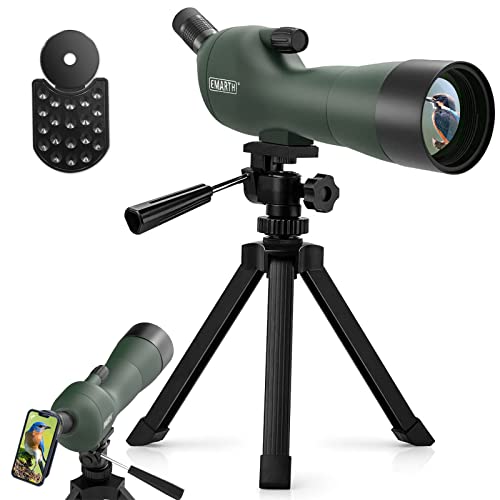
- ✓ Ultra-light and portable
- ✓ Clear, HD optics
- ✓ Stable tripod included
- ✕ Slightly limited eye relief
- ✕ No smartphone adapter
| Magnification Range | 20x to 60x |
| Objective Lens Diameter | 60mm |
| Optical Performance | High-definition HD optics |
| Tripod Compatibility | Standard 1/4 inch-20 tripod thread |
| Waterproof and Fogproof | Yes, nitrogen-filled and waterproof construction |
| Weight | 1.31 lbs |
The first thing that catches your eye is how lightweight this spotting scope feels—just about 1.31 pounds—but don’t let that fool you. It feels solid in your hand, and the soft shoulder-strap case makes carrying it around effortless, whether you’re heading into the woods or setting up at the range.
As you look through the high-definition optics, the clarity and brightness stand out. The 20-60x zoom is smooth and precise, letting you scan wide areas at low power and then zoom in for sharp details at 60x.
It’s perfect for spotting birds from a distance or zeroing in on distant targets without any fuzziness.
The included 14-inch tripod is a real game-changer. Its wider legs grip uneven terrain securely, so you won’t have to worry about shaky images or tipping over.
I tested it on gravel and grass, and it stayed rock-steady, even with a slight breeze.
The wide field of view at 20x makes it easy to find your target quickly, then zoom in for close-up observation. Switching between the two is seamless, so you don’t miss out on the action.
The focus is smooth and accurate, which is crucial when you’re hunting or birdwatching.
Built to handle the outdoors, this scope is waterproof and fogproof. It’s survived light rain and dew without any issues, and the matte surface provides a good grip—even with gloves.
It’s versatile enough for hunting, camping, surveillance, or just scenic sightseeing.
Plus, the standard tripod thread means you can attach it to various mounts, from car window mounts to full-size tripods. It’s a flexible little tool that covers a wide range of outdoor activities, all at an affordable price point.
What Features Should You Consider When Choosing a Spotting Scope?
When choosing a spotting scope, there are several key features to consider to ensure you select the best spotting scope on the market.
- Magnification: The magnification power of a spotting scope is critical as it determines how close you can see distant objects. Common magnification ranges are from 15x to 60x, and higher magnification allows for better detail but can also make images shakier without a sturdy tripod.
- Objective Lens Diameter: The diameter of the objective lens affects how much light the scope can gather, influencing image brightness and clarity. A larger diameter typically allows for better performance in low-light conditions, making it crucial for dawn or dusk observations.
- Field of View: The field of view indicates how wide an area you can see through the scope at a specific distance. A wider field of view is beneficial for tracking moving objects, while a narrower field may be more suitable for detailed observation of stationary targets.
- Lens Coatings: Quality lens coatings can significantly enhance light transmission and reduce glare, resulting in clearer and brighter images. Look for fully multi-coated lenses, as they provide the best optical performance by minimizing reflections and optimizing light efficiency.
- Weight and Portability: The weight of a spotting scope can affect how easily you can transport it, especially for outdoor activities like birdwatching or hunting. Choose a model that balances optics quality with portability, as heavier scopes may require a more robust tripod.
- Durability and Weather Resistance: A durable construction is essential for a spotting scope to withstand harsh environments. Look for scopes that are waterproof, fog-proof, and made from robust materials to ensure longevity and reliable performance in varying weather conditions.
- Eye Relief: Eye relief is the distance you can be from the eyepiece while still seeing the full image. Adequate eye relief is particularly important for those who wear glasses, as it allows for comfortable viewing without straining the eyes or needing to remove glasses.
- Tripod Compatibility: A stable tripod is essential for using a spotting scope effectively, especially at higher magnifications. Ensure that the spotting scope is compatible with a variety of tripods and consider purchasing a high-quality tripod to enhance stability and reduce vibration.
How Do Different Brands Compare for Spotting Scopes?
| Brand | Magnification | Price | Weight | Objective Lens Diameter | Field of View | Waterproof Features | Warranty |
|---|---|---|---|---|---|---|---|
| Brand A | 20-60x – Versatile for various distances | $300 – Mid-range pricing | 3.5 lbs – Lightweight for portability | 50 mm – Good light transmission | 120 ft/1000 yds – Wide view | Yes – Submersible | Lifetime warranty |
| Brand B | 15-45x – Ideal for closer viewing | $150 – Budget-friendly option | 4 lbs – Slightly heavier but stable | 40 mm – Compact design | 100 ft/1000 yds – Decent view | No – Not suitable for heavy rain | 1 year warranty |
| Brand C | 25-75x – Excellent for long-range observation | $600 – Higher-end pricing | 4.5 lbs – More robust construction | 60 mm – Excellent for low light | 90 ft/1000 yds – Narrower view | Yes – Nitrogen-purged | 5 year warranty |
What Are the Key Specifications to Look for in a Spotting Scope?
When searching for the best spotting scope on the market, several key specifications should be considered to ensure optimal performance and usability.
- Magnification: The magnification power determines how close you can see objects. Spotting scopes typically have a range of magnification, often from 15x to 60x, allowing you to view distant subjects in detail, which is essential for birdwatching, hunting, or surveillance.
- Objective Lens Diameter: This specification refers to the diameter of the front lens, measured in millimeters. A larger objective lens allows more light to enter the scope, resulting in brighter and clearer images, especially in low-light conditions, making it a crucial factor for evening or early morning observations.
- Field of View: The field of view (FOV) indicates how wide an area you can see through the scope at a specific distance, typically measured in feet at 1000 yards. A wider FOV helps in tracking moving subjects and provides a better overall viewing experience, particularly in dynamic environments.
- Optical Quality: The quality of the glass and coatings used in the lenses affects image clarity and brightness. High-quality, fully multi-coated optics enhance light transmission and reduce glare, ensuring crisp, clear images even in challenging lighting situations.
- Eye Relief: Eye relief is the distance from the eyepiece to your eye where you can comfortably see the entire field of view. A longer eye relief is beneficial for users who wear glasses, providing comfort and preventing strain during extended viewing sessions.
- Durability and Build Quality: Spotting scopes should be rugged and able to withstand various environmental conditions. Look for scopes that are waterproof, fog-proof, and have a durable housing to protect against impacts and harsh weather, ensuring longevity and reliability.
- Weight and Portability: Consider the weight of the spotting scope, especially if you plan to carry it for long periods. Lightweight scopes are easier to transport and set up in the field, making them more suitable for outdoor activities such as hiking or birdwatching.
- Tripod Compatibility: A sturdy tripod is essential for stabilizing a spotting scope, particularly at higher magnifications. Many scopes come with a built-in mounting point for tripods, ensuring you can achieve steady, shake-free views.
How Do Price Points Affect Quality in Spotting Scopes?
The price points of spotting scopes significantly influence their quality and performance characteristics.
- Entry-Level Spotting Scopes: These are typically priced under $200 and are ideal for beginners or casual users. While they offer basic features and decent optics, they may struggle with image clarity and distortion, especially at higher magnifications.
- Mid-Range Spotting Scopes: Priced between $200 and $800, these scopes usually provide a noticeable improvement in optical quality, build materials, and durability. They often include better lens coatings, which enhance light transmission and reduce glare, making them suitable for more serious birdwatchers and hunters.
- High-End Spotting Scopes: With prices exceeding $800, these scopes are designed for professionals and enthusiasts seeking the best performance. They feature advanced optics, superior build quality, and often come with extensive warranties, ensuring clear images even in low light conditions and at high magnifications.
- Premium Features: At higher price points, spotting scopes may include features such as ED (extra-low dispersion) glass, advanced lens coatings, and weatherproofing. These enhancements contribute to sharper images, better color accuracy, and overall robust performance in challenging environments.
- Brand Reputation: Higher-priced scopes often come from established brands known for rigorous quality control and customer service. Investing in a reputable brand can provide peace of mind regarding product reliability and resale value.
What Spotting Scopes Are Recommended for Birdwatching?
Some of the best spotting scopes on the market for birdwatching include:
- Swarovski ATX/STX: This premium spotting scope offers exceptional optical performance, with high-quality glass that provides bright and clear images. Its modular design allows for interchangeable objective lenses, making it versatile for various birdwatching scenarios.
- Vortex Razor HD: Known for its durability and excellent optics, the Vortex Razor HD features high-density, extra-low dispersion glass that enhances color fidelity and clarity. It is also lightweight and compact, making it easy to carry on long birdwatching hikes.
- Leupold SX-4 Pro Guide HD: This scope is designed for rugged use, featuring a waterproof and fog-proof construction. The Leupold SX-4 Pro Guide HD offers impressive image quality with a wide field of view, making it easier to track moving birds.
- Kowa TSN-883: Renowned for its outstanding image quality, the Kowa TSN-883 uses a large 88mm objective lens that captures bright images even in low light conditions. Its angled body design allows for comfortable viewing angles during extended birdwatching sessions.
- Meopta MeoStar S2: This spotting scope combines high-quality optics with a rugged build, providing excellent brightness and color reproduction. The MeoStar S2’s innovative design includes a dual-focus mechanism, allowing for precise focusing on distant subjects.
- Bushnell Legend Ultra HD: A more budget-friendly option, the Bushnell Legend Ultra HD offers impressive performance with ED glass for improved image clarity and color accuracy. It features a lightweight design and is both waterproof and fog-proof, making it suitable for various weather conditions.
Which Spotting Scopes Are Best for Hunting?
The best spotting scopes on the market for hunting combine durability, optical clarity, and versatility.
- Leupold SX-5 Santiam HD: This spotting scope is known for its exceptional optical performance and rugged construction.
- Vortex Razor HD: With its superior glass quality and advanced coatings, this model provides bright, clear images even in low light.
- Swarovski ATX/STX: This modular system offers outstanding image quality and allows for customization based on the user’s needs.
- Zeiss Conquest Gavia: This scope offers a wide field of view and impressive optical clarity, making it a great choice for spotting game from a distance.
- Nikon Prostaff 5: A budget-friendly option that doesn’t compromise on quality, this scope delivers reliable performance for hunters.
The Leupold SX-5 Santiam HD features a powerful magnification range and a lightweight, waterproof design, making it easy to carry on long hunting trips. Its Twilight Max HD Light Management System enhances visibility during dawn and dusk, crucial times for hunting.
The Vortex Razor HD is highly regarded for its high-definition glass and advanced lens coatings that maximize light transmission and minimize glare. Its rugged, shockproof construction ensures it can withstand tough outdoor conditions, making it ideal for serious hunters.
The Swarovski ATX/STX system stands out with its modular design, allowing hunters to switch eyepieces and objective lenses for varying magnification and field of view. Its exceptional image quality, with high contrast and color fidelity, makes it a favorite among those who prioritize optical excellence.
The Zeiss Conquest Gavia is designed for versatility, featuring a wide field of view that allows for easy tracking of moving game. Its high-quality optics provide sharp images, even at longer distances, which is essential for effective hunting.
The Nikon Prostaff 5 is an excellent entry-level spotting scope that offers great performance for its price. It features multicoated lenses for brightness and clarity, and its compact design makes it easy to transport without sacrificing functionality.
How Does the Best Spotting Scope Enhance Your Viewing Experience?
Portability is another important factor, especially for those who travel or hike to remote locations. A lightweight and compact spotting scope can be easily carried in a backpack, allowing users to enjoy their viewing experience without the burden of heavy equipment.
Related Post: