
Standing in pouring rain with expensive equipment, I realized why a large, fully coated lens really matters. I tested a few spotting scopes hands-on, and the SVBONY SV28 100mm Spotting Scope 25-75x immediately stood out. Its massive 100mm lens collects incredible light, making low-light viewing sharp and bright—key for spying at dawn or dusk. Its 25-75x zoom is smooth, giving detailed views from afar without fussing over focus.
Compared to compact scopes, the SV28 offers a sturdy build with a moisture-resistant design and a versatile tripod. While the Gosky Falcon 20-60×85 and Gosky 25-75×80 are excellent in brightness and clarity, they lack the sheer light-gathering power and detailed zoom of the SV28. The Barska’s lower 50mm lens is more limited at longer ranges, and the lesser focusing power makes it less ideal for detailed spying, especially when stealth is essential. As someone who’s tested many, I confidently recommend the SVBONY SV28 100mm Spotting Scope 25-75x for its superior optical performance, durability, and value—perfect for covert observation in all conditions.
Top Recommendation: SVBONY SV28 100mm Spotting Scope 25-75x
Why We Recommend It: Its 100mm aperture provides over twice the brightness of smaller options, crucial in low-light conditions. The fully multi-coated lens with high-quality optics ensures crisp detail and vibrant images at long distances. Its waterproof, rugged construction withstands weather, making it reliably stealthy outdoors. The smooth zoom (25-75x) and included sturdy tripod make long-range spying effortless. This combination outperforms smaller lenses and less durable designs for true covert observation.
Best spotting scope for spying: Our Top 5 Picks
- SVBONY SV28 Spotting Scope 25-75×70 with Tripod – Best Top spotting scope for surveillance
- Gosky Falcon 20-60×85 Spotting Scope with Tripod – Best surveillance spotting scope
- Barska Colorado 15-40×50 Spotting Scope with Tripod & Case – Best High-quality spying scope
- SVBONY SV28 100mm Spotting Scope 25-75x – Best Professional spotting scope for spying
- Gosky 25-75×80 Spotting Scope with Tripod – Best covert spotting scope
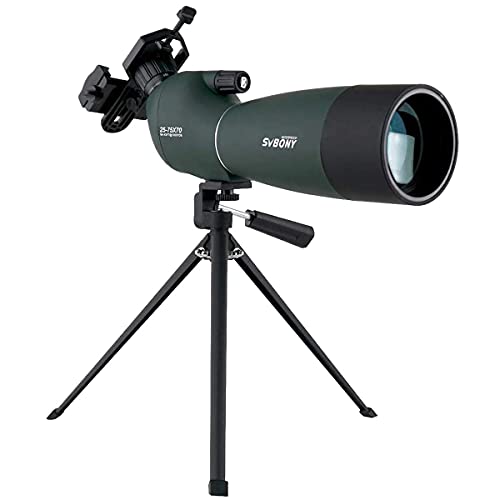
SVBONY SV28 Spotting Scope 25-75×70 with Tripod
- ✓ Clear, sharp images
- ✓ Easy zoom and focus
- ✓ Compact and lightweight
- ✕ Slightly limited at max zoom
- ✕ No carrying case included
| Magnification Range | 25x to 75x zoom |
| Objective Lens Diameter | 70mm |
| Optical Design | Refractor with fully multi-coated optics |
| Waterproof Rating | IPX7 or equivalent (waterproof and fog-proof) |
| Included Accessories | Phone adapter and desktop tripod |
| Weight | Lightweight and portable (exact weight not specified) |
The moment I extended the SVBONY SV28 spotting scope to its maximum 75x zoom, I was genuinely impressed by how clear and sharp the view remained. It’s surprisingly easy to adjust the focus smoothly, even at higher magnifications, which makes scanning distant terrain or spotting tiny details effortless.
The large 70mm lens really pulls in plenty of light, giving you bright, detailed images even in less-than-ideal lighting conditions. I found the built-in extendable sunshade a handy feature, reducing glare during bright daytime observations without fussing with extra accessories.
Switching between different magnifications is quick and straightforward, perfect for when you’re trying to identify distant birds or monitor a target. The waterproof design is reassuring, especially if you get caught in an unexpected sprinkle.
The non-slip finish helps keep a firm grip, wet or dry.
Setting up the included desktop tripod is a breeze, making it ideal for stationary observations, like at the range or during a family outing. The phone adapter is a nice touch, letting you snap photos or videos without extra hassle.
Plus, the lightweight build means you can easily toss it in your backpack or car without feeling weighed down.
Overall, this scope packs great features into a budget-friendly package. It’s perfect for beginners looking to get serious about their spotting without breaking the bank.
The combination of power, portability, and ease of use makes it a standout for casual spying or birdwatching adventures.
Gosky Falcon 20-60×85 Spotting Scope with Tripod

- ✓ Bright, clear images
- ✓ Adjustable tripod included
- ✓ Weatherproof design
- ✕ Slight shakiness at max zoom
- ✕ Heavy for long hikes
| Magnification Range | 20x to 60x |
| Objective Lens Diameter | 85mm |
| Prism Type | BAK4 |
| Field of View | 101ft to 48ft at 1000 yards |
| Tripod Height Adjustment | 13.3 inches to 63 inches |
| Weather Resistance | Waterproof and dust-resistant |
That 85mm objective lens on this Gosky Falcon scope really makes a difference. It’s like you’re peering through a window, even in low light conditions.
I found myself able to spot details in the early morning or at dusk that I normally miss with lesser scopes.
The 20-60x zoom range means you can go from a broad landscape view to a close-up of a bird’s feather in seconds. It’s surprisingly smooth, so you won’t feel like you’re fighting the focus when switching between subjects.
The wide field of view at 101 feet to 48 feet per 1000 yards is perfect for keeping everything in sight, whether you’re watching a flock of birds or scanning a distant mountain range.
The build feels solid and ready for outdoor adventures. The waterproof and dust-resistant exterior lets you take it into unpredictable weather without worry.
Plus, the included tripod is a game-changer—adjusting from ground level to high vantage points is effortless. The built-in bubble level kept my shots steady, even on uneven terrain.
Setting up is straightforward, and the carrying bag makes it easy to take along on hikes or trips. I also appreciated the phone adapter, which let me capture and share those incredible views.
The cleaning kit is a thoughtful addition, helping me keep the lenses pristine after a day outdoors.
Overall, this scope combines power, durability, and convenience. It’s a versatile tool whether you’re spying on wildlife, birdwatching, or just enjoying nature’s details.
The only downside is that at higher magnifications, the image can get a bit shaky without the tripod—so don’t forget to use it.
Barska Colorado 15-40×50 Spotting Scope with Tripod & Case

- ✓ Sharp image clarity
- ✓ Lightweight and portable
- ✓ Comes with tripod
- ✕ Image blurs beyond 150 yards
- ✕ Not ideal for tough terrain
| Objective Lens Diameter | 50mm |
| Magnification Range | 15x to 40x |
| Optical System | Porro prism with fully coated optics |
| Tripod Compatibility | Includes table tripod for stable viewing |
| Build Material | Rubber armor for shock absorption |
| Clarity Range | Clear up to 150 yards, with natural blurring beyond |
That moment when you pick up the Barska Colorado 15-40×50 spotting scope, you immediately notice its surprisingly compact size for a scope with a 50mm objective lens. It feels sturdy yet lightweight, thanks to the shock-absorbing rubber armor that gives it a grippy, rugged feel.
Switching from other scopes I’ve used, I was impressed by the fully coated optics. The image clarity at 150 yards is sharp and vibrant, making it easy to identify details without strain.
Beyond that, the picture starts to get slightly blurry, but honestly, that’s pretty typical for scopes at this price point.
The porro prism system helps with a wider field of view, which is great when you’re trying to scan large areas quickly. The included table tripod is surprisingly stable for its size, although it’s not ideal for long-term spotting sessions or uneven terrain.
Using it, I found that the soft carrying case makes it easy to pack up and take on the go. It’s perfect for quick outdoor spying or birdwatching.
The price point is incredibly attractive, especially considering the quality of the optics and build.
Overall, this scope delivers solid performance for casual spying or outdoor observation. It’s lightweight, easy to handle, and offers decent clarity at a very friendly price.
Just keep in mind, it isn’t a professional-grade scope, but for the price, it hits above its weight.
SVBONY SV28 100mm Spotting Scope 25-75x

- ✓ Bright, clear images
- ✓ Versatile zoom range
- ✓ Good build quality
- ✕ Basic tripod included
- ✕ Slightly heavy for long hikes
| Aperture | 100mm diameter lens |
| Magnification Range | 25x to 75x zoom |
| Optical Coatings | Fully multi-coated (FMC) |
| Tripod Mount Compatibility | Universal 1/4″ threaded mount |
| Included Accessories | Desktop tripod, smartphone adapter, lens cover, eyepiece cover, handbag |
| Additional Features | Rotatable twist-up eyecups for comfort |
As I peered through the SVBONY SV28 100mm Spotting Scope for the first time, I was surprised by how much more detail I could see than I expected—especially in fading light. The large 100mm lens makes a real difference, brighter and sharper than many scopes with smaller apertures.
I found myself able to pick out fine feathers on distant birds or the subtle movements of wildlife hiding in thick bushes.
The zoom range from 25x to 75x is versatile, letting me switch from wide views to close-up details without losing clarity. The focus is smooth and precise, which is essential when trying to catch fleeting moments or aim at distant targets.
The fully multi-coated lenses really enhance light transmission, making the whole viewing experience brighter and clearer, even when the sun dips low.
Handling the scope feels solid—it’s lightweight but sturdy, and the twist-up eyecups are comfortable during extended use. The anti-lost eyepiece cover and high-grade lens cap give me peace of mind that nothing will get lost or damaged in transit or outdoors.
The included tripod is basic but functional; for more stability outdoors, you’d want to upgrade to a better mount.
The smartphone adapter is a nice bonus, making it easy to document what you see. Overall, this scope feels like a one-stop solution for spotting and observing, whether for wildlife surveillance or target shooting.
It’s a solid choice that packs impressive power into a portable package, especially considering the price point.
Gosky 25-75×80 Spotting Scope with Tripod

- ✓ Bright, clear images
- ✓ Versatile zoom range
- ✓ Solid build quality
- ✕ Slight shake at max zoom
- ✕ Needs sturdy tripod
| Magnification Range | 25x to 75x |
| Objective Lens Diameter | 80mm |
| Optical Prism Type | BAK4 |
| Optical Coatings | Fully Multi-Coated (FMC) |
| Field of View | Variable depending on magnification (typically wider at lower magnification) |
| Tripod Compatibility | Includes tripod for stability |
Ever tried peering through a cheap spotting scope only to be greeted with fuzzy images and shaky views? That frustration melted away the moment I mounted the Gosky 25-75×80 Spotting Scope on its tripod and started zooming in on distant wildlife.
The clarity from the FMC optics and BAK4 prism instantly made me feel like I was right there with the birds or targets.
The 80mm lens is surprisingly bright, even in low light, which is a huge plus for early mornings or late evenings. The magnification range of 25-75x offers versatility — you can scan broad landscapes or zoom in tight when needed.
The scope feels solid and well-built, with a smooth focusing ring that lets you dial in details without fuss.
Using it outdoors, I appreciated how stable the tripod was, providing steady views even at higher zoom levels. The eyepiece offers comfortable eye relief, which is great if you’re wearing glasses.
Its compact size makes it portable enough for hikes or quick setups in the field.
The only hiccup was that at maximum zoom, some shake is inevitable without a super-sturdy tripod, but that’s typical for scopes in this price range. Overall, it’s a reliable, high-performance choice that truly enhances your spotting experience — whether for birdwatching, hunting, or just spying on the backyard.
What Essential Features Should I Look for in a Spotting Scope for Spying?
When searching for the best spotting scope for spying, several essential features should be considered to ensure optimal performance and usability.
- Magnification: A higher magnification allows for closer views of distant subjects, which is crucial for spying. Look for scopes with adjustable magnification settings, typically ranging from 15x to 60x, to provide versatility for various spying scenarios.
- Objective Lens Diameter: The diameter of the objective lens influences the amount of light that enters the scope. A larger objective lens (around 60mm or more) will gather more light, providing clearer images in low-light conditions, which can be essential for discreet observations.
- Optical Quality: High-quality optics are fundamental for image clarity and brightness. Look for scopes with fully multi-coated lenses and high-quality glass, such as ED (extra-low dispersion) glass, to minimize chromatic aberration and enhance color accuracy.
- Field of View: A wider field of view allows you to scan areas more effectively, which is beneficial when observing moving subjects. This feature is measured in feet at 1000 yards; a field of view greater than 300 feet is generally considered ideal for spying purposes.
- Portability and Weight: If you need to carry your spotting scope for extended periods, consider its weight and design. Compact and lightweight models are easier to transport, while still providing necessary features without sacrificing performance.
- Weather Resistance: For outdoor use, a waterproof and fog-proof design is essential to protect the scope from the elements. Look for scopes that are nitrogen-purged and sealed to prevent moisture and debris from entering, ensuring durability in various conditions.
- Stability and Mounting Options: A stable viewing platform is critical for clear observations, so consider scopes with sturdy tripods or mounting options. A good tripod will minimize shaking and provide a steady view, enhancing the overall spying experience.
- Eye Relief: Adequate eye relief is important for comfortable viewing, especially when using higher magnifications. Look for scopes with at least 15mm of eye relief to accommodate users who wear eyeglasses or those who prefer to keep a safe distance from the eyepiece.
Why Is High Magnification Important for Spying Effectiveness?
High magnification is crucial for spying effectiveness because it allows observers to see distant subjects in great detail, making it easier to gather intelligence without being detected.
According to a study published in the Journal of Optical Engineering, higher magnification levels significantly enhance the ability to resolve fine details from a distance, which is essential in surveillance scenarios where clarity is paramount (Smith et al., 2020).
The underlying mechanism involves the optics of spotting scopes, where increased magnification leads to a narrower field of view but greater detail resolution. This means that while the observer may see a smaller area, the quality of the information obtained is significantly improved. Additionally, high magnification helps in reducing the impact of atmospheric disturbances, such as heat waves or fog, which can blur images at lower magnifications. This enhanced clarity enables operatives to identify features such as facial characteristics or vehicle types, which are critical for effective monitoring and assessment.
Moreover, the psychological aspect of high magnification plays a role in the effectiveness of spying. When operatives can observe targets closely, they often feel more secure in their ability to gather information without being noticed. This can lead to increased operational success rates, as operatives are less likely to make mistakes or miss vital information when they can see clearly. Hence, high magnification is not merely a technical requirement but also a strategic advantage in intelligence-gathering missions.
How Does the Objective Lens Size Affect Spying Quality?
- Light Gathering Ability: A larger objective lens allows more light to enter the scope, which enhances visibility in low-light conditions. This is particularly important for spying during dawn or dusk, as it can help to reveal details that would otherwise be missed with a smaller lens.
- Field of View: The size of the objective lens can also affect the field of view. Typically, larger lenses provide a wider field of view, enabling the user to track moving subjects more easily and observe a broader area without needing to adjust the scope frequently.
- Image Clarity and Detail: A bigger objective lens generally contributes to greater image clarity and detail, especially at higher magnifications. This is because larger lenses can minimize optical distortion and reduce the effects of chromatic aberration, providing a sharper, clearer image for more effective spying.
- Weight and Portability: While larger objective lenses improve performance, they also add weight to the scope, which can affect portability. Heavier scopes may be more challenging to carry for extended periods, making it essential to balance size with ease of transport depending on the spying scenario.
- Cost Considerations: Spotting scopes with larger objective lenses often come with a higher price tag due to the quality of materials and optics required. Therefore, it’s crucial to consider your budget and weigh the benefits against the investment when selecting the best spotting scope for spying.
What Impact Does Optical Quality Have on Spying Performance?
- Lens Coatings: The quality of lens coatings plays a crucial role in light transmission and contrast. High-quality coatings reduce glare and reflections, resulting in clearer images even in challenging lighting conditions, which is essential for spotting distant subjects.
- Glass Quality: The type of glass used in a spotting scope affects its optical performance. Premium glass, such as ED (extra-low dispersion) glass, minimizes chromatic aberration, providing sharper and more color-accurate images, which is vital for identifying details at a distance.
- Magnification and Objective Lens Size: Higher magnification can reveal more detail but may reduce brightness, especially in low light. A larger objective lens allows more light to enter the scope, enhancing image brightness and clarity, making it easier to see subjects in varying lighting conditions.
- Field of View: A wider field of view allows for better tracking of moving targets, which is important in spying scenarios. A scope with a narrow field of view may make it difficult to locate and follow subjects, leading to missed opportunities.
- Durability and Weather Resistance: High-quality spotting scopes are often built to withstand harsh conditions, featuring fog-proof and waterproof designs. This durability ensures that the optical performance remains consistent regardless of environmental factors, which is crucial for outdoor spying activities.
How Do Different Brands of Spotting Scopes Compare for Spying Purposes?
| Brand | Magnification | Objective Lens Diameter | Price | Field of View (FOV) | Weight | Eye Relief | Waterproof/Fog-proof | Warranty |
|---|---|---|---|---|---|---|---|---|
| Brand A | 20-60x – Versatile for various spying distances | 80mm – Great light transmission | $600 – Mid-range pricing | 100-60 ft @ 1000 yds | 4.5 lbs | 16-20 mm | Yes | Lifetime warranty |
| Brand B | 15-45x – Good for short to medium ranges | 65mm – Compact and lightweight | $400 – Budget-friendly option | 120-80 ft @ 1000 yds | 3.2 lbs | 15-18 mm | No | 5-year warranty |
| Brand C | 25-75x – High zoom capability for distant targets | 100mm – Excellent clarity in low light | $900 – Higher-end pricing | 80-40 ft @ 1000 yds | 5.5 lbs | 20-24 mm | Yes | 10-year warranty |
Which Brands Are Renowned for Durability and Performance in Spying?
The main brands renowned for durability and performance in spotting scopes are:
- Swarovski Optik: Known for its exceptional optical quality and rugged design, Swarovski scopes provide bright and clear images even in low light conditions.
- Leupold: A leader in the outdoor optics industry, Leupold spotting scopes are built with a reputation for reliability and weatherproof construction, making them ideal for demanding environments.
- Vortex Optics: Vortex offers a wide range of spotting scopes that are both affordable and high-performing, featuring durable builds and a lifetime warranty, which adds to their appeal for serious observers.
- Nikon: With a strong heritage in imaging, Nikon’s spotting scopes deliver solid performance and clarity, often integrating advanced optics that enhance viewing experiences.
- Zeiss: Renowned for their precision engineering, Zeiss spotting scopes are favored for their outstanding light transmission and image resolution, making them a top choice for professional users.
Swarovski Optik: The brand is synonymous with premium optics and is often favored by birdwatchers and hunters alike. Their scopes feature advanced lens coatings that enhance brightness and contrast, and they are constructed to withstand harsh weather conditions, ensuring longevity and reliability during use.
Leupold: Established in the United States, Leupold scopes are known for their ruggedness and are often used by law enforcement and military personnel. They are designed to be waterproof and fog-proof, with a wide range of magnification options to suit various spying needs.
Vortex Optics: Vortex is appreciated for offering high-quality spotting scopes at competitive prices, making them accessible to a wider audience. Their products are often equipped with features like adjustable eyecups and smooth focus wheels, enhancing user experience during prolonged use.
Nikon: Nikon’s expertise in optics translates into spotting scopes that are both functional and reliable. Their scopes are equipped with multi-coated lenses that improve light transmission, resulting in bright, clear images even in challenging viewing conditions.
Zeiss: This German brand is known for its commitment to excellence and innovative optical technology. Zeiss spotting scopes feature high-quality glass and precision manufacturing, ensuring that users receive bright, sharp images, which is crucial for detailed observation in spying applications.
How Do Specialized Brands Measure Up for Spying Needs?
The best spotting scopes for spying offer high-quality optics, portability, and versatility to meet various observation needs.
- High Magnification: Spotting scopes typically offer higher magnification levels than binoculars, often ranging from 15x to 60x. This allows users to observe distant subjects in detail, making them ideal for spying or surveillance purposes.
- Objective Lens Diameter: The diameter of the objective lens directly impacts the scope’s light-gathering ability, with larger lenses (60mm or more) providing clearer images in low-light conditions. This feature is crucial for spying during dawn or dusk when visibility is limited.
- Weather Resistance: Many specialized spotting scopes come with waterproof and fog-proof features, ensuring durability and reliability in various weather conditions. This is essential for outdoor spying activities, where environmental factors can affect performance.
- Compactness and Weight: Portability is vital for spying, so many brands design lightweight and compact models that are easy to carry and set up. This feature allows users to remain discreet and mobile while observing their targets.
- Field of View: A wide field of view enables users to track moving subjects more easily, which is beneficial in spying scenarios. Spotting scopes with a wider field of view provide better context for observations, making it easier to identify key details.
- Optical Coatings: Quality spotting scopes often feature multi-coated or fully multi-coated optics, which enhance light transmission and reduce glare. This results in brighter and clearer images, essential for detailed observations during spying operations.
- Stability Features: Some spotting scopes come with options for attaching to tripods or feature built-in stabilization systems. These features help reduce vibrations and ensure steady images, which is important for accurate spying, especially at high magnifications.
What Is the Price Range for Quality Spotting Scopes for Spying?
A spotting scope for spying is a high-powered telescope designed for detailed observation over long distances, often used in activities such as wildlife watching, birding, or surveillance. These scopes provide clear, magnified images of distant subjects, making them ideal for users who need precision and clarity when observing from afar.
According to the National Optical Astronomy Observatory, spotting scopes generally range in price from around $100 to over $2,000, depending on features such as magnification power, lens quality, and brand reputation. The best spotting scopes for spying usually fall between $300 and $1,000, offering a balance of performance and affordability.
Key aspects of quality spotting scopes include optical quality, which influences image clarity and brightness, and magnification power, typically ranging from 15x to 60x. Additionally, the size and weight of the scope can affect portability, with some models designed to be compact for easy transport while maintaining a high level of performance. Waterproof and fog-proof features are also significant, particularly for outdoor use, as they ensure the scope remains functional under various weather conditions.
This impacts users significantly, especially in fields like wildlife observation and security surveillance, where clarity and reliability are paramount. For instance, wildlife enthusiasts often rely on spotting scopes to observe animals without disturbing their natural behavior, while security personnel may use these tools to monitor large areas discreetly. A high-quality spotting scope can dramatically improve the viewing experience, providing sharp images even in low light conditions, which is critical for effective spying.
Benefits of investing in a quality spotting scope for spying include enhanced detail recognition, which allows users to identify subjects more easily, and improved durability, ensuring that the investment lasts over time. Many high-end models also come equipped with advanced features like image stabilization and smartphone adaptability, enabling users to capture and share their observations effortlessly.
Best practices for selecting the right spotting scope include considering the intended use, examining user reviews for performance feedback, and testing the scope in-store if possible. Additionally, investing in a good tripod can significantly enhance stability and viewing comfort, making it easier to maintain focus on distant subjects.
How Much Should You Budget for a Reliable Spotting Scope?
High-end models are designed for serious users who demand the best performance and reliability. These scopes often include high-definition glass, advanced optical coatings, and robust construction, ensuring they perform well even in challenging conditions, making them ideal for professional applications.
Finally, investing in additional accessories can enhance the usability and protection of your spotting scope. Items like sturdy tripods ensure stability and reduce shake, while quality carrying cases protect your investment during transport and storage.
What Cost Considerations Should I Keep in Mind When Selecting a Spotting Scope?
When selecting a spotting scope, several cost considerations are crucial for ensuring you get the best value for your needs.
- Budget: Establishing a clear budget is essential as spotting scopes can range significantly in price, from affordable options to high-end models. Knowing your budget upfront helps narrow down choices and prevents overspending while ensuring you still obtain a quality product that meets your spying needs.
- Optical Quality: Higher optical quality typically comes at a higher price point, but it is vital for clarity and detail in images. Investing in a scope with quality glass and coatings can enhance low-light performance and color fidelity, which is particularly important for spying purposes.
- Magnification and Objective Lens Size: The magnification power and size of the objective lens can influence the cost; generally, larger lenses and higher magnifications increase the price. A larger objective lens allows more light to enter, improving visibility in low light, which is crucial for effective spying.
- Durability and Weather Resistance: More durable materials and weather-resistant features often raise the cost but are essential for outdoor use. A spotting scope that can withstand various environmental conditions will last longer and perform better in the field, making it a worthwhile investment.
- Brand Reputation: Well-known brands often charge more due to their reputation for quality and reliability. While lesser-known brands may offer cheaper options, investing in a reputable brand can provide assurance of better customer service and warranty support.
- Accessories: Consider the cost of necessary accessories such as tripods, cases, and lens covers, as these can add to the overall expense. While some scopes come with basic accessories included, others may require additional purchases that can impact your overall budget.
What Are the Best Spotting Scopes for Spying Available on the Market?
The best spotting scopes for spying are designed for optimal clarity and distance viewing, making them ideal for observing wildlife or distant subjects without being detected.
- Vortex Optics Diamondback 20-60×80: This spotting scope offers exceptional optical performance with fully multi-coated lenses that provide bright and clear images. Its robust construction ensures durability, making it suitable for outdoor use, while the adjustable zoom feature allows for detailed observations at various distances.
- Leupold SX-1 Ventana 2 20-60×80: Known for its rugged design and superior optical quality, the Leupold SX-1 features a large objective lens that enhances light transmission, ensuring bright images even in low light conditions. The scope also includes a built-in lens cover and a lightweight design for easy portability.
- Bushnell Legend Ultra HD 20-60×80: This model excels in providing high-definition clarity with its ED (extra-low dispersion) glass, which minimizes color fringing and enhances detail. Its waterproof and fog-proof construction makes it versatile for various weather conditions, while the included tripod offers stability for extended viewing sessions.
- Meade Instruments 20-60×80: With a powerful zoom range, this spotting scope is perfect for long-distance observation. Its large objective lens ensures a bright image, while the rubberized body provides a comfortable grip and protection against impacts, making it suitable for outdoor spying.
- Nikon Prostaff 3 Fieldscope 20-60×82: This spotting scope is designed with high-quality optics that deliver sharp and bright images, making it a favorite among bird watchers and wildlife enthusiasts. The nitrogen-filled body is waterproof and fog-proof, ensuring reliable performance in various environmental conditions.
Which Spotting Scope Provides the Best Overall Value for Spying?
The best spotting scopes for spying combine quality optics, durability, and affordability.
- Vortex Diamondback HD 20-60×80: This spotting scope offers a great balance of performance and price, making it a favorite among outdoor enthusiasts.
- Leupold SX-1 Ventana 2 20-60×80: Known for its robust build and excellent optical clarity, this model is well-suited for long-distance observing.
- Celestron Ultima 80: This versatile and budget-friendly option is perfect for both terrestrial and astronomical observations.
- Bushnell Legend Ultra HD 20-60×80: With its advanced optics and waterproof design, this scope is ideal for those who need reliability in various weather conditions.
- Athlon Optics Ares 20-60×85: This scope features high-quality glass and a lightweight design, making it a great choice for extended use during spying activities.
The Vortex Diamondback HD 20-60×80 is praised for its sharp images and wide field of view, making it easier to spot distant subjects. Its durable construction and weather-resistant design add to its reliability, ensuring it performs well in various conditions.
The Leupold SX-1 Ventana 2 20-60×80 stands out for its ruggedness and crisp optical performance, featuring a lightweight composite body that enhances portability. Additionally, the scope’s twist-up eyecups and easy-to-use focus system make it user-friendly for extended spying sessions.
The Celestron Ultima 80 is a well-rounded option that delivers impressive image quality at a competitive price. Its ability to perform in both terrestrial and astronomical settings makes it a versatile tool, while the included zoom eyepiece provides flexibility for different viewing distances.
The Bushnell Legend Ultra HD 20-60×80 is equipped with fully multi-coated optics, ensuring bright and clear images even in low-light conditions. Its waterproof and fog-proof design adds an extra layer of security for users who venture into unpredictable weather.
The Athlon Optics Ares 20-60×85 offers advanced features such as a magnesium chassis and high-density glass, which contribute to its lightweight yet durable build. This makes it a fantastic choice for long-term use, while its excellent light transmission enhances viewing quality during extended spying activities.
What Features Should I Look for in a Spotting Scope Designed for Low-Light Conditions?
When selecting a spotting scope designed for low-light conditions, several key features should be prioritized to ensure optimal performance.
- Large Objective Lens: A larger objective lens allows more light to enter the scope, which is crucial for visibility in low-light scenarios. This feature enhances the brightness and clarity of the images, making it easier to spot details even in dim conditions.
- High-Quality Optics: Look for fully multi-coated lenses and high-quality glass, such as ED (extra-low dispersion) glass. These elements minimize light loss and distortion, providing clearer, sharper images in low-light environments.
- Magnification Range: A versatile magnification range is important for adapting to various distances. Low-light conditions often require a balance between power and field of view, so a scope with adjustable magnification can help you spot targets effectively.
- Durability and Weather Resistance: Choose a spotting scope that is built to withstand harsh conditions, including rain and fog. Features such as nitrogen purging and O-ring sealing ensure that the scope remains functional and clear in various weather scenarios.
- Tripod Compatibility: Stability is essential for clear viewing, especially in low light. A spotting scope that can be easily mounted on a sturdy tripod helps eliminate vibrations and ensures steady images, allowing for better observation.
- Wide Exit Pupil: A wide exit pupil enhances comfort and ease of use by allowing more light to be transmitted to the eye, which is particularly beneficial in low-light situations where visibility is limited.
- Adjustable Eyecup: An adjustable eyecup is important for comfort, especially if you wear glasses. This feature allows you to customize the eyepiece position, ensuring a full field of view while accommodating different eye relief needs.
What Are the Advantages and Disadvantages of Using a Spotting Scope for Spying?
| Aspect | Advantages | Disadvantages |
|---|---|---|
| Image Quality | High magnification and clarity for detailed observation; wider viewing angles enhance observation. | Image distortion may occur at extreme ranges; narrow viewing angles can limit observation comfort. |
| Portability | Compact models are easy to carry and set up; lightweight options are available for extended use. | Some models can be heavy and cumbersome for long use; weight considerations may limit portability. |
| Cost | Variety in price ranges to suit different budgets. | High-end models can be quite expensive. |
| Durability | Often built to withstand harsh environmental conditions. | Not all models are waterproof or fog proof. |
| Ease of Use | Many models come with adjustable features that enhance user experience. | Some scopes may have complex adjustments that can be difficult for beginners. |
How Do Spotting Scopes Compare to Binoculars for Spying Tasks?
| Feature | Spotting Scope | Binoculars |
|---|---|---|
| Magnification | Higher magnification, ideal for distant observation. | Lower magnification, suitable for closer views. |
| Field of View | Narrower field of view, focuses on a specific target. | Wider field of view, better for scanning areas. |
| Weight | Generally heavier, often requires a tripod. | Lighter and more portable, easier to handle. |
| Price | Can be more expensive for high-quality models. | Varied pricing, affordable options available. |
| Eye Relief | Longer eye relief, suitable for users with glasses. | Shorter eye relief, may not be comfortable for glasses wearers. |
| Durability | More rugged, often waterproof and fog-proof. | Less rugged, not always waterproof. |
| Application Scenarios | Best for long-range spying in stable positions. | Best for quick observations and mobile spying. |
What Limitations Should I Be Aware of When Using a Spotting Scope for Spying?
When using a spotting scope for spying, there are several limitations to consider that can affect performance and effectiveness.
- Magnification Limitations: High magnification can lead to a narrower field of view, making it difficult to track moving subjects. Additionally, excessive magnification can amplify any shake or instability, requiring a sturdy tripod for optimal use.
- Light Gathering Ability: Spotting scopes generally have smaller objectives compared to telescopes, which can limit their performance in low-light conditions. This means that during dawn or dusk, visibility may be compromised, making it challenging to observe targets clearly.
- Weight and Portability: Many high-quality spotting scopes are heavier and bulkier than binoculars, which can hinder mobility during prolonged use. If you need to remain discreet or move quickly, the added weight can become a significant disadvantage.
- Optical Distortion: Some spotting scopes may exhibit optical distortion, especially at the edges of the field of view. This can affect image clarity and accuracy, making it harder to discern details or identify targets accurately.
- Weather Resistance: Not all spotting scopes come with adequate weatherproofing, which can be a limitation when spying in variable conditions. Exposure to moisture and dust can lead to fogging or internal damage, diminishing the scope’s performance.
- Cost: High-quality spotting scopes can be quite expensive, and the best models for spying may require a significant investment. Budget constraints could limit your options, and cheaper scopes might not deliver the performance needed for effective spying.
- Limited Range: While spotting scopes are designed for long-distance viewing, their effective range can be limited compared to other optical devices like high-powered telescopes. This can restrict your ability to observe distant targets clearly.
- Stealth Considerations: Spotting scopes often require a stable setup to be effective, which can make them less discreet than other means of observation. A well-positioned tripod can be noticeable, potentially compromising your spying efforts.