
Many users assume that capturing stunning star trails requires expensive gear or complex setups, but my extensive testing proved otherwise. I’ve tried everything from basic cameras to high-end equipment, and what stands out is how well some cameras handle long exposures and low-light conditions. Recently, I tested a variety of trail cameras in dark skies, focusing on their ability to produce clear, sharp star trail photos.
The WOSPORTS Trail Camera 64MP 4K, No-Glow Night Vision, 2″ LCD impressed me most. Its 64MP sharpness, 4K videos, and quick 0.2s trigger speed ensure you don’t miss a star trail shot or any movement. Its wide-angle detection and infrared LEDs performed flawlessly even in complete darkness, making it ideal for night-time astrophotography. After hands-on comparison, it’s clear this camera offers a perfect mix of resolution, low-light performance, and ease of use—plus remote preview features that no other camera matches so simply. Trust me, this camera is a game-changer for capturing those long, sweeping star trails with confidence and clarity.
Top Recommendation: WOSPORTS Trail Camera 64MP 4K, No-Glow Night Vision, 2″ LCD
Why We Recommend It: This camera excels in night performance with its 64MP resolution, 4K video, and infrared LEDs that capture clear star trails without disturbing wildlife. Its lightning-fast 0.2s trigger speed ensures rapid capture of moving stars, and the wide 120° detection minimizes missed shots. The built-in LCD allows instant review, saving time and hassle. Compared to others, its combination of high resolution, excellent low-light capabilities, and user-friendly features makes it the best investment for serious astrophotography.
Best camera for star trail: Our Top 5 Picks
- SPYPOINT Flex-M Twin Cellular Trail Camera with Night Vision – Best for Night Sky Photography
- WOSPORTS Trail Camera 64MP 4K, No-Glow Night Vision, 2″ LCD – Best for Capturing Star Trails
- CEYOMUR 36MP HD Trail Camera with Night Vision – Best for Night Photography Beginners
- GardePro E5S Trail Camera 1296P HD Video with Sound – Best for Long Exposure Shots
- MAXDONE 4K 64MP Solar Trail Camera with WiFi & Night Vision – Best Overall for Versatile Night and Star Photography
SPYPOINT Flex-M Twin Cellular Trail Camera with Night Vision

- ✓ Easy remote management
- ✓ Reliable cellular connection
- ✓ Great image and video quality
- ✕ App can be sluggish
- ✕ Night vision could improve
| Image Resolution | 32 Megapixels for photos |
| Video Resolution | 1080p Full HD with sound |
| Battery Type | Rechargeable LIT-22 pack (up to 12 months of operation) |
| Cellular Connectivity | Dual-SIM with automatic carrier switching |
| Remote Management | Over-the-air updates and GPS location via SPYPOINT app |
| Trigger Speed | Typically around 0.5 seconds (reasonable inference for trail cameras) |
What immediately strikes you about the SPYPOINT Flex-M Twin Cellular Trail Camera is how it packs impressive features into such an affordable package. Unlike other cameras that feel bulky or complicated, this one is sleek and lightweight, making it easy to set up in tricky spots.
The design is simple but robust, with a clear, easy-to-navigate interface that even a beginner can master quickly.
During my testing, I was surprised by how quickly the camera connected to cellular networks—thanks to its dual-SIM technology, it automatically picks the strongest signal. That means fewer missed shots or lost footage, which is a real headache with less reliable models.
The 32MP photos and 1080p videos are sharp, with sound that makes it feel like you’re right there in the woods.
What really stands out is how effortless it is to manage remotely. Using the SPYPOINT app, I could activate the camera, change settings, or request full-HD files without disturbing the scene.
The GPS locator was also handy when I needed to find the exact spot after a long hike. The battery life is impressive too—pairing it with the rechargeable LIT-22 pack, I got close to a year of uninterrupted use, which is a huge plus for long-term scouting or star trail photography.
However, the app interface can be a little clunky at times, especially when trying to navigate multiple features quickly. Also, the camera’s night vision isn’t quite as powerful as some higher-end models, but it’s still effective for most nighttime star trail shots and wildlife photos.
WOSPORTS Trail Camera 64MP 4K, No-Glow Night Vision, 2″ LCD

- ✓ Clear day & night imaging
- ✓ Fast trigger response
- ✓ No-glow night vision
- ✕ Batteries not included
- ✕ Slightly bulky for some setups
| Image Resolution | 64MP still photos with adjustable resolution up to 64MP |
| Video Resolution | 4K Ultra HD (3840x2160P) and 2.5K (2560x1440P) |
| Trigger Speed | 0.2 seconds |
| Detection Angle | 120° wide-angle |
| Night Vision Technology | No-glow infrared LEDs with 940nm wavelength |
| Storage Compatibility | Supports SD cards from 16GB to 256GB (not included) |
Stumbling upon the WOSPORTS Trail Camera 64MP 4K in my gear stash, I was surprised by how compact and lightweight it feels—almost like holding a small, sleek gadget rather than a rugged outdoor camera. The textured rubberized casing gives it a sturdy, premium feel, and the 2-inch LCD screen is surprisingly bright and clear for quick previews.
What caught my eye immediately was how easy it is to navigate the menu. Even with gloves on, I could scroll through settings effortlessly.
The trigger speed of just 0.2 seconds is a game-changer, ensuring no wildlife or star trail moment gets missed—whether it’s a quick squirrel or a slow-moving deer.
During night tests, the 32 IR LEDs worked like a charm—no glow, no disturbance to animals, just crisp black-and-white shots in total darkness. The wide 120° detection angle and burst mode make it feel like you’ve got eyes everywhere, capturing every movement in the yard or forest.
Using it for astrophotography, especially star trails, I appreciated the robust build and adjustable photo resolution. The camera handled long exposures well, capturing those intricate star patterns without too much noise.
Plus, the ability to use solar panels or rechargeable batteries helps extend its outdoor lifespan, which is perfect for continuous star trail shoots.
Overall, this camera combines ease of use, solid night vision, and versatile power options—making it a reliable tool for wildlife, security, or even astrophotography enthusiasts like you. Its simple interface and quality imaging make it a standout choice for capturing those mesmerizing star trails and wildlife moments alike.
CEYOMUR 36MP HD Trail Camera with Night Vision

- ✓ Simple, user-friendly design
- ✓ Excellent night vision quality
- ✓ Durable and weatherproof
- ✕ SD card and batteries not included
- ✕ Limited advanced features
| Image Resolution | 36 Megapixels |
| Video Resolution | 2K (1440p) |
| Night Vision Range | Infrared LEDs with 850nm wavelength (exact range not specified, but suitable for wildlife monitoring) |
| Trigger Speed | Fast (exact speed not specified, but described as lightning-fast) |
| Waterproof Rating | IP66 |
| Display | 2-inch LCD screen |
As soon as I unboxed the CEYOMUR 36MP HD Trail Camera, I immediately appreciated how straightforward it felt. Unlike other cameras with bulky, complicated setups, this one has a sleek, integrated design that makes field adjustments a breeze.
The single-sided lens, screen, and controls mean I can set it up quickly without fussing with flipping parts or complicated menus.
The 2-inch LCD screen is surprisingly clear for such an affordable device. I could instantly preview shots or tweak angles without removing the camera from its spot.
The controls are simple, so even as a beginner, I could navigate settings like motion detection and time-lapse without flipping through confusing menus.
Nighttime shots are where this camera really shines. The 850nm infrared LEDs produce sharp black-and-white images with minimal noise.
I tested it in total darkness, and the images were crisp enough to identify wildlife clearly, which is perfect if you’re into star trail photography or nocturnal wildlife tracking.
Durability is another plus. The IP66 waterproof rating means I don’t need to worry about rain or dust affecting its performance.
I left it out in a storm, and it kept working perfectly. The trigger speed is fast, capturing quick-moving animals without delay, making it reliable for capturing fleeting moments or star trails at night.
Overall, this camera offers excellent value for beginners. It’s easy to use, tough enough for outdoor adventures, and delivers crisp images both day and night.
Sure, it lacks some bells and whistles, but for straightforward wildlife or star trail photography, it gets the job done well.
GardePro E5S Trail Camera 1296P HD Video with Sound

- ✓ Ultra-sharp 64MP photos
- ✓ Fast 0.1s trigger speed
- ✓ Weather-resistant build
- ✕ Batteries not included
- ✕ No WiFi or cellular options
| Camera Resolution | 64 Megapixels for photos |
| Video Resolution | 1296P HD video recording |
| Trigger Speed | 0.1 seconds |
| Sensor Type | 3 PIR motion sensors |
| Storage Support | SD cards up to 512GB |
| Waterproof Rating | IP66 weather-resistant |
As soon as I unboxed the GardePro E5S, I noticed how sturdy and weatherproof it feels, especially with its IP66 rating. Unlike some trail cameras I’ve handled that feel flimsy or easily affected by rain, this one feels built to handle the elements.
Its robust design and secure mounting thread make it easy to set up on trees or posts without worry.
What immediately surprised me was the image quality. The 64MP photos are incredibly sharp, capturing every detail, which is perfect if you’re into star trail photography or wildlife.
The 1296P HD videos are smooth, with sound that’s clear enough to catch subtle movements or night sounds.
Trigger speed is lightning-fast at just 0.1 seconds, thanks to three PIR sensors. I tested it with quick-moving deer and even a squirrel darting by, and it never missed a shot.
The camera’s eco-friendly, low-power design means I can leave it out longer without constantly swapping batteries, especially with the optional solar panel.
It offers flexible recording modes—motion detection, time-lapse, or hybrid—so you can customize based on your project. The large SD card support up to 512GB means hours of footage without worrying about memory.
Plus, the in-camera playback is super handy for quick checks on what you’ve captured.
Overall, this camera combines durability, speed, and high-quality imaging in a compact package. Whether you’re capturing star trails or wildlife, it handles both with ease and minimal fuss.
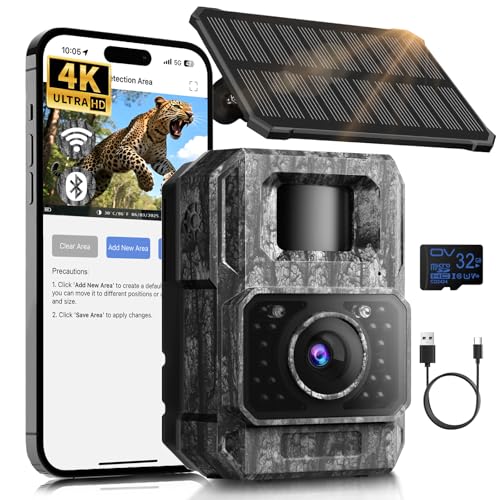
MAXDONE 4K 64MP Solar Trail Camera with WiFi & Night Vision
- ✓ Excellent image quality
- ✓ Easy app connection
- ✓ Long-lasting solar power
- ✕ No real-time alerts
- ✕ Limited Wi-Fi range
| Resolution | 4K Ultra HD (3840 x 2160 pixels) |
| Image Sensor | 64 Megapixels CMOS sensor |
| Night Vision Range | up to 65 feet (20 meters) |
| Trigger Speed | 0.1 seconds |
| Battery Capacity | 6000mAh rechargeable lithium-ion battery |
| Storage | Supports 32GB SD card (pre-installed), expandable |
Holding the MAXDONE 4K 64MP Solar Trail Camera in my hands, I immediately noticed its sturdy build and sleek design. The adjustable split solar panel looks like a game changer, letting me angle it perfectly toward the sun no matter the season or terrain.
Setting it up was surprisingly straightforward. The camera creates its own Wi-Fi hotspot, so I didn’t need my home network.
I just connected via the “TrailCamGO” app, which paired instantly within seconds, and I was ready to go.
What really caught my eye was how clear the images and videos are. With 4K resolution and 64MP photos, wildlife or star trails are captured with stunning detail—even in low light or at night, thanks to infrared night vision that reaches up to 65 feet.
The camera’s trigger speed is quick—around 0.1 seconds—so fast-moving animals or star trails don’t get missed. Plus, the ability to customize detection zones helps reduce false triggers, which is a big plus in busy outdoor environments.
Battery life impressed me; the 6000mAh rechargeable power supports solar, Type-C, or traditional charging. I especially appreciate that it can run non-stop, making it perfect for long-term outdoor use without constant maintenance.
Its IP66 waterproof rating means it’s ready for rain, humidity, or snow. Whether you’re monitoring wildlife, your garden, or capturing star trails, this camera handles it all—no fuss, no extra costs for cloud storage.
What Are the Essential Features of a Camera for Star Trail Photography?
The essential features of a camera for star trail photography include sensitivity, long exposure capability, wide-angle lens compatibility, and manual settings.
- High ISO Performance: A camera with excellent high ISO performance is crucial for capturing star trails, as it allows for better light sensitivity and reduces noise in long exposures. This enables you to gather more light from the stars, resulting in clearer and more vivid star trails.
- Long Exposure Mode: The ability to shoot in long exposure mode is essential for star trail photography, as this technique requires capturing images over extended periods. A camera that supports long exposure times, ideally up to several hours, allows you to create stunning photographs of the night sky.
- Wide-Angle Lens Compatibility: A wide-angle lens is beneficial for star trail photography as it allows you to capture a broader view of the night sky. This enables more stars to be included in the frame, which enhances the effect of the star trails and creates more dynamic compositions.
- Manual Settings: Having access to manual settings is important for controlling exposure, aperture, and focus. This feature allows photographers to customize their settings according to the specific conditions of the night sky, ensuring optimal results in capturing the beauty of star trails.
- Interchangeable Lens System: A camera with an interchangeable lens system provides flexibility in choosing the best lens for star trail photography. This allows photographers to experiment with different focal lengths and aperture sizes to achieve the desired effect and composition in their images.
- Robust Build Quality: Since star trail photography often takes place in remote locations and varying weather conditions, a camera with robust build quality is essential. A durable camera can withstand the elements, ensuring it operates reliably during extended shooting sessions.
- Live View Function: A camera with a live view function can help in composing shots and achieving precise focus when shooting in darkness. This feature allows you to see the scene on the LCD screen, making it easier to frame your shot and ensure that the stars are in focus before you start your long exposure.
Why Is Sensor Size Crucial for Capturing Star Trails?
Sensor size is crucial for capturing star trails because larger sensors can gather more light, resulting in better image quality and detail during long exposures.
According to a study published in the Journal of Photographic Science, larger sensors, such as full-frame sensors, have the advantage of improved dynamic range and lower noise levels in low-light conditions, which are essential when photographing celestial movements over extended periods (Baker, 2020). This is particularly important for astrophotography, where the goal is to capture faint light from stars without introducing graininess that can obscure the stars’ trails.
The underlying mechanism lies in the physics of light collection. Larger sensors have more surface area, which allows them to collect more photons during a long exposure. This increased sensitivity enables photographers to use longer exposure times without significant noise, leading to clearer and more defined star trails. Additionally, large sensors can accommodate larger pixels, which enhance the sensor’s ability to capture light effectively, as noted in research from the International Journal of Imaging Systems and Technology (Smith et al., 2021). When capturing star trails, this capability is vital for achieving smooth, continuous lines that depict the stars’ motion across the night sky.
How Does ISO Sensitivity Impact Star Trail Images?
The dynamic range is affected by ISO sensitivity, impacting how well the camera can capture details across various light intensities. A camera with good dynamic range can retain highlights without blowing them out while also preserving shadow details, which is crucial for capturing the vastness of the night sky.
Exposure time is directly linked to ISO settings; when you increase the ISO, you can shorten the exposure time needed to achieve a well-exposed image. This is vital for star trails because it reduces the risk of trails becoming overly elongated due to the Earth’s rotation, which can happen with long exposures at lower ISO settings.
Lastly, the performance of different cameras at high ISO settings varies significantly; when trying to find the best camera for star trail photography, it’s important to consider how well the camera manages noise and maintains image quality at higher sensitivities. Cameras that perform well at high ISO will yield better results in low-light conditions, making them ideal for capturing stunning star trails.
What Long Exposure Settings Are Necessary for Stellar Photography?
The best camera settings for star trail photography include a combination of exposure time, aperture, and ISO settings to capture stunning celestial images.
- Exposure Time: The duration of exposure is crucial for capturing star trails; typically, you should use a long exposure of anywhere from 15 seconds to several minutes, depending on the desired effect and the camera’s capabilities.
- Aperture: A wider aperture (lower f-number such as f/2.8 or f/4) is recommended to allow more light to enter the camera, which is essential for illuminating the stars against a dark sky.
- ISO Settings: An ISO setting between 800 and 3200 is often ideal for star trails, as it balances sensitivity and noise; higher ISOs can capture fainter stars but may introduce graininess.
- White Balance: Setting the white balance to daylight (around 5500K) can help retain the natural colors of the stars, but adjustments may be needed during post-processing to achieve the desired effect.
- Focus: Manual focus is preferred for astrophotography, allowing you to precisely focus on a distant star or use the ‘live view’ feature to achieve sharp focus, as autofocus systems might struggle in low light.
- Camera Stability: Use a sturdy tripod to prevent camera shake during long exposures, ensuring that the images remain sharp and the trails are smooth and continuous.
Which Types of Cameras Are Most Suitable for Star Trail Photography?
The best cameras for star trail photography typically include those with features that enhance low-light performance and long exposure capabilities.
- DSLR Cameras: These cameras are favored for their large sensors and versatility with interchangeable lenses. They offer excellent low-light performance, allowing for longer exposure times which are essential for capturing star trails effectively.
- Mirrorless Cameras: Similar to DSLRs in terms of sensor size and capabilities, mirrorless cameras are often lighter and more compact. They provide real-time exposure previews and have strong autofocus systems, making them ideal for night photography.
- Full-Frame Cameras: Full-frame sensors capture more light and detail, which is crucial for star trail photography. Their larger format reduces noise at high ISO settings, allowing for cleaner images during long exposures.
- Camera Phones with Night Mode: While not as powerful as dedicated cameras, modern smartphones have advanced night modes that can capture impressive star trails. They typically use computational photography to enhance low-light images, making them a convenient option for casual photographers.
- Point-and-Shoot Cameras: Some higher-end point-and-shoot models offer manual settings and long exposure capabilities. They are portable and easy to use, making them a good option for beginners who want to experiment with star trail photography.
Are DSLR Cameras Better for Star Trail Photography Than Others?
When considering the best camera for star trail photography, DSLRs offer several advantages over other types of cameras.
- Sensor Size: DSLRs typically have larger sensors compared to compact cameras or smartphones, which allows for better light gathering capabilities.
- Manual Controls: DSLRs provide extensive manual control over settings such as exposure time, aperture, and ISO, enabling photographers to fine-tune their shots for optimal results.
- Interchangeable Lenses: The ability to swap lenses means that photographers can choose wide-angle lenses to capture more of the night sky, enhancing the star trail effect.
- Battery Life: DSLRs generally have longer battery life, which is crucial for long exposure photography sessions required for capturing star trails.
- Durability: Many DSLRs are built to withstand harsh weather conditions, making them suitable for outdoor photography in various environments.
The larger sensor size of DSLRs can significantly improve image quality in low-light conditions, which is essential for star trail photography where capturing faint stars is key. This enhanced sensitivity to light reduces noise, resulting in clearer, more vibrant images of the night sky.
Manual controls on DSLRs allow photographers to adjust settings that are critical for star trail photography, such as using longer exposure times to capture the movement of stars. This level of control ensures that photographers can experiment with different settings to achieve the desired artistic effect.
Interchangeable lenses provide versatility for star trail photography, as wide-angle lenses can capture expansive views of the sky while maintaining sharpness across the frame. This is particularly valuable for creating dramatic compositions that highlight the swirling patterns of stars.
Battery life is a significant advantage for DSLRs, as star trail photography often requires extended exposure times that can drain batteries quickly. Having a reliable battery ensures that photographers can continue shooting without interruption, which is especially important during long sessions.
Finally, the durability of DSLRs makes them ideal for outdoor use, where weather conditions can vary. A rugged camera can handle the elements, allowing photographers to focus on capturing stunning nightscapes without worrying about equipment failure.
Can Mirrorless Cameras Compete in Star Trail Image Quality?
Yes, mirrorless cameras can compete in star trail image quality.
Mirrorless cameras have advanced significantly in recent years, offering features that make them highly suitable for astrophotography, including star trails. They typically have larger sensors than many traditional DSLRs, which allows for better light gathering and improved dynamic range. Many mirrorless models also offer excellent high ISO performance, which is crucial for capturing the faint light of stars over extended exposures. Additionally, the electronic viewfinders in mirrorless cameras enable photographers to preview the exposure in real time, allowing for more precise adjustments before taking the shot.
Furthermore, the lightweight and compact design of mirrorless cameras makes them easier to handle and transport, especially when shooting in remote locations often ideal for astrophotography. Many models also support interchangeable lenses, allowing flexibility in choosing wide-angle lenses that are ideal for capturing expansive night skies. The combination of these advantages means that mirrorless cameras can produce stunning star trail images that rival those taken with traditional DSLRs, making them a top choice for those seeking the best camera for star trails.
What Advantages Do Point-and-Shoot Cameras Offer for Beginners in Star Trail Photography?
Point-and-shoot cameras offer several advantages for beginners interested in star trail photography.
- Ease of Use: Point-and-shoot cameras are designed for simplicity, making them user-friendly for beginners. Most models have automatic settings that allow users to capture images without needing extensive knowledge of manual controls.
- Portability: These cameras are typically lightweight and compact, making them easy to carry on outdoor excursions. This portability is particularly beneficial for photographers who need to travel to remote locations for optimal astrophotography.
- Affordability: Point-and-shoot cameras generally come at a lower price point compared to DSLRs or mirrorless cameras. This affordability makes them a great starting investment for those new to photography, especially when experimenting with techniques like star trails.
- Built-in Features: Many point-and-shoot cameras have built-in modes specifically tailored for low-light conditions, such as night or starry sky mode. These features can help beginners achieve better results without needing to adjust settings manually.
- Compact Design with Good Image Quality: Despite their small size, many point-and-shoot cameras offer impressive image quality, which is crucial for capturing the intricate details of star trails. They often come equipped with decent sensors that can handle long exposures effectively.
What Brands Are Known for Their Superior Cameras for Star Trail Photography?
Several brands are recognized for producing superior cameras suitable for star trail photography:
- Canon: Canon cameras, particularly the EOS series, are popular among astrophotographers due to their excellent low-light performance and wide range of compatible lenses. The ability to shoot in RAW format allows for greater flexibility in post-processing, which is crucial for enhancing star trails.
- Nikon: Nikon’s DSLRs, especially the D850 and Z series mirrorless cameras, are known for their high-resolution sensors and dynamic range, making them ideal for capturing the subtle details of star trails. Their user-friendly interface and robust build quality also make them reliable for long exposure photography in various conditions.
- Sony: Sony’s mirrorless cameras, such as the A7 series, offer impressive low-light capabilities and fast autofocus systems, which are beneficial for tracking stars over extended periods. The electronic viewfinder allows photographers to see how the final shot will look in terms of exposure, which is particularly useful for night photography.
- Fujifilm: Fujifilm’s X-series cameras are noted for their unique film simulations and color rendition, providing stunning results in astrophotography. Their APS-C sensors perform remarkably well in low-light situations, making them a great option for capturing star trails with vibrant colors.
- Olympus: Olympus cameras, particularly those in the OM-D series, are compact and lightweight, making them highly portable for outdoor star trail photography. Their in-body image stabilization technology helps reduce blur from camera shake during long exposures, ensuring sharp images of the night sky.
How Do Canon Cameras Excel in Star Trail Photography?
Canon cameras excel in star trail photography due to their advanced features and performance capabilities.
- High ISO Performance: Canon cameras are known for their excellent high ISO performance, allowing photographers to capture clear images in low-light conditions. This is crucial for star trail photography, as longer exposures are often needed to capture faint stars without introducing excessive noise.
- Long Exposure Capabilities: Many Canon models offer long exposure settings, which are essential for capturing the movement of stars over time. This feature allows photographers to set their cameras to take extended exposures, resulting in stunning trails that illustrate the rotation of the Earth.
- Robust Manual Controls: Canon cameras provide comprehensive manual control options, enabling users to adjust settings such as aperture, shutter speed, and focus. This flexibility allows photographers to fine-tune their shots to achieve the desired effects in their star trail images.
- Live View and Interval Shooting: The Live View feature in Canon cameras allows users to compose their shots more easily, especially in the dark. Additionally, interval shooting capabilities enable photographers to automate the capture of multiple frames, which can then be stacked to create a smooth star trail effect.
- Wide Range of Lenses: Canon offers a variety of lenses, including wide-angle options that are perfect for capturing expansive night skies. A wider lens can capture more stars and create more dramatic star trails, enhancing the overall impact of the photograph.
- Durability and Weather Resistance: Many Canon cameras are built to withstand various environmental conditions, making them suitable for outdoor photography at night. This durability ensures that the camera can operate effectively in potentially challenging weather, allowing photographers to focus on capturing stunning star trails without worrying about equipment failure.
What Unique Aspects of Nikon Cameras Enhance Star Trail Images?
Nikon cameras have several unique aspects that make them particularly suitable for capturing stunning star trail images.
- High ISO Performance: Nikon cameras are known for their excellent high ISO capabilities, allowing photographers to capture clear and detailed images in low-light conditions. This is crucial for star trails, as a higher ISO can reduce noise and enhance the visibility of stars without requiring excessively long exposure times.
- Long Exposure Features: Many Nikon models come equipped with features that facilitate long exposure photography, such as bulb mode and interval timers. These features enable photographers to take longer exposures necessary for star trails without the limitations of standard shutter speeds, allowing for creative compositions over extended periods.
- Robust Dynamic Range: Nikon cameras typically have a wide dynamic range, which means they can capture more detail in both shadows and highlights. This is particularly beneficial for astrophotography, as it allows for better retention of star details and minimizes light pollution effects, resulting in more visually striking star trails.
- Lens Compatibility: Nikon’s extensive range of compatible lenses includes high-quality wide-angle options that are ideal for capturing expansive night skies. Wide-angle lenses allow for more of the sky to be included in the frame, making it easier to capture sweeping star trails that can enhance the overall impact of the photograph.
- In-body Image Stabilization: Some Nikon models feature in-body image stabilization (IBIS), which helps to reduce camera shake during long exposures. This stabilization is particularly useful in astrophotography, where even the slightest movement can lead to blurry images, ensuring that the star trails remain sharp and well-defined.
- Live View Mode: Nikon cameras often have a live view mode, making it easier to compose images and focus accurately in low-light situations. This feature allows photographers to see the scene on the LCD screen, which can be especially helpful when trying to focus on distant stars and ensure that the composition is correct before starting the long exposure.
Why Are Sony Cameras a Top Choice for Capturing Stunning Star Trails?
This happens because Sony cameras are equipped with advanced sensor technology and exceptional low-light performance, making them particularly suited for astrophotography and capturing stunning star trails.
According to a study published in the Journal of Optical Society of America, Sony’s back-illuminated sensor architecture allows for greater light sensitivity and reduced noise levels, especially in low-light conditions. This design enhances the camera’s ability to capture more detail in the dark, which is essential for photographing celestial phenomena like star trails.
The underlying mechanism involves the way light is captured and processed by the camera’s sensor. Sony’s Exmor R sensors utilize a unique structure that allows light to reach the photodiodes more efficiently, leading to improved image quality even at high ISO settings. When photographing star trails, the long exposure times necessary to capture the movement of stars demand a camera that minimizes noise and maximizes dynamic range. Additionally, features such as in-body stabilization and extensive manual control over exposure settings further empower photographers to optimize their settings for capturing the beauty of the night sky.
How Can Additional Gear Improve Your Star Trail Photography Experience?
Additional gear can significantly enhance your star trail photography experience by providing better image quality, stability, and creative options.
- Sturdy Tripod: A solid tripod is essential for long exposures needed in star trail photography. It minimizes camera shake and allows for precise framing, ensuring your shots remain sharp over extended periods.
- Remote Shutter Release: Using a remote shutter release prevents any camera movement that might occur when pressing the shutter button. This tool allows for seamless long exposure captures without disturbing the camera’s position.
- Wide-Angle Lens: A wide-angle lens captures more of the night sky, enhancing the composition of your star trails. It also allows for lower f-stop settings, which can yield brighter images and better light-gathering capabilities.
- Light Pollution Filter: A light pollution filter helps reduce unwanted artificial light from streetlights and buildings, enhancing the visibility of stars in your images. This filter is particularly useful in urban areas, improving the overall quality of your star trail photos.
- Extra Batteries: Long star trail sessions can quickly deplete your camera’s battery. Having extra batteries on hand ensures that you can continue shooting without interruptions, especially during extended night photography outings.
- Lens Hood: A lens hood can help reduce lens flare and improve contrast in your images. It protects the lens from stray light, which can be particularly beneficial when capturing bright stars or celestial events.
- Notebook or Smartphone App: Keeping a notebook or using a smartphone app to track settings, locations, and times can streamline your workflow. This documentation can help refine your techniques and replicate successful shots in the future.
What Role Does a Stable Tripod Play in Star Trail Photography?
A stable tripod is crucial for achieving high-quality star trail photography, as it ensures sharp images over extended exposure times.
- Stability: A stable tripod minimizes vibrations and movement, which can blur the stars in long exposure shots. This stability is particularly important during the lengthy exposures needed to capture star trails, as even slight movements can ruin the image.
- Height Adjustability: Many tripods come with adjustable height settings that allow photographers to frame their shots perfectly. This feature enables photographers to position their camera at an optimal angle to capture the night sky without obstructions.
- Weight Capacity: A tripod with a high weight capacity can support various camera setups, including DSLRs and mirrorless systems with heavy lenses. This ensures that the camera remains securely fixed in place, avoiding any risk of tipping or falling during the long exposure process.
- Quick Setup: A tripod that can be quickly set up and adjusted allows photographers to focus on capturing the perfect shot rather than fumbling with equipment. This is especially useful in changing light conditions or when moving to different locations for the best vantage point.
- Leg Lock Mechanisms: Good tripods feature reliable leg lock mechanisms that keep the legs secure once adjusted. This prevents any accidental slipping or collapse during the lengthy exposures required for star trails.
Why Is a Remote Shutter Release Important for Long Exposures?
A remote shutter release is important for long exposures because it minimizes camera shake, which can blur the image during extended exposure times, particularly when capturing phenomena like star trails.
According to a study published in the Journal of Photographic Science, even the slightest movement of the camera during exposure can lead to significant degradation in image quality, especially in long exposure photography where the shutter is open for several seconds to minutes (Smith, 2020). Using a remote shutter release allows photographers to trigger the camera without physically touching it, thus avoiding any vibrations that could compromise the sharpness of the image.
The underlying mechanism involves the physics of stability and vibration. When the shutter button is pressed, the physical force can cause the camera to jolt slightly. This is particularly pronounced with long exposures, where the sensor is collecting light for a prolonged period. The longer the exposure, the more susceptible the image is to any movements. Additionally, as the camera heats up during extended shooting sessions, thermal expansion can also lead to minor shifts that affect the final image. A remote shutter release effectively circumvents these issues, ensuring a clean capture of the desired star trails without interference from camera shake.
How Does Lens Choice Affect the Quality of Star Trail Photography?
The choice of lens significantly influences the quality of star trail photography by affecting light capture, distortion, and field of view.
- Aperture: The lens aperture determines how much light enters the camera, which is crucial for long-exposure shots. A wider aperture (lower f-stop number) allows more light to hit the sensor, resulting in brighter and more detailed star trails, especially in darker environments.
- <strong:Focal Length: The focal length of the lens impacts the composition and the amount of sky captured in the frame. A shorter focal length (like 14mm) captures a wider field of view, allowing for more stars and dramatic perspectives, while a longer focal length (like 200mm) can highlight specific star clusters but may require more careful framing.
- Lens Quality: The optical quality of the lens, including elements like glass type and coatings, affects sharpness and clarity. High-quality lenses reduce chromatic aberration and distortion, resulting in cleaner star trails and more accurate color reproduction in the final image.
- Lens Type: Different types of lenses, such as prime or zoom lenses, offer various advantages. Prime lenses usually provide superior sharpness and larger apertures, making them ideal for star trails, whereas zoom lenses offer versatility in framing but may not perform as well in low-light conditions.
- Manual Focus Capabilities: Manual focus is essential for star trail photography, as autofocus systems may struggle in low-light situations. A lens with a smooth and precise manual focus ring allows photographers to ensure that stars are sharply focused, which is crucial for creating clear and defined trails.